Indian Journal of Pharmacy and Pharmacology
Indian Journal of Pharmacy and Pharmacology (IJPP) is an open-access, peer-reviewed pharmacy journal, published quarterly, as print and online by the Innovative Education and Scientific Research Foundation (IESRF) since 2014. we will be publishing articles ‘Ahead of Print’ immediately upon acceptance of manuscript. In addition, the journal allows free access (Open Access) to its contents, which is likely to attract more readers and citations to articles published in journal.Manuscripts should be prepared in accordance with the author guidelines of the journal, which follow the recommendations...
Prescription pattern in elderly: A look out for potentially inappropriate medications

Abstract
Background: The elderly population is increasing in India. Polypharmacy and inappropriate prescriptions are the major concerns while prescribing to the elderly patients. The Beers criteria is a tool to identify inappropriate prescription in the elderly. The objective of this study was to describe the prescribing pattern in elderly patients and to estimate the proportion of inappropriate prescribing through Beers criteria.
Materials and Methods: This cross-sectional study was conducted in the Department of Medicine and Pharmacology at a tertiary care center in Central Kerala after obtaining Institutional Ethics Committee Clearance. Case records of inpatients aged ≥ 65years for a period of 6 months (March to August 2020) were screened and the data were collected in a structured proforma which was analyzed using SPSS 16 for windows.
Results: Amongst the 124 case records reviewed, diseases related to cardiovascular system 33 (27%) were the main cause of admission. The major categories of drugs prescribed were from gastrointestinal (GI) system 96 (77.4%) followed by the those acting on blood and cardiovascular system. According to Beers criteria, 43 (53.32%) prescriptions had potentially inappropriate medications in elderly.
Conclusion: The most widely prescribed groups of drugs were related to the gastrointestinal system and the cardiovascular system. Potentially inappropriate medications identified in the elderly warrants extra caution while prescribing to the elderly.
1. Introduction
The demographic transition in India driven by improvement in healthcare and living conditions have seen an increase in the ageing population.[1] The definitions of elderly are variable, an accepted standard being 60 as defined by the United Nations and in India; while most research defines it at 65 years and further the multidimensional old age threshold in India has been estimated at 67 years.[1][2][3][4] As per the statistics in 2024, the elderly comprise a little over 10% of the population in India and is projected to reach 19.5% by 2050.[2]
Age-related changes which comprise anatomical, physiological, pharmacokinetic, pharmacodynamic, functional as well as cognitive parameters and higher incidence of chronic diseases have been directly linked with polypharmacy, drug interactions and adverse effects in the elderly.[3] Inappropriate prescribing in the elderly runs in parallel with the over and under prescription particularly when potential age bias influence decision making.[5] Inappropriate prescribing can also be due to the use of uninformd and unsafe self-medication which increases the likelihood of harm unless properly monitored.[6] The American Geriatrics Society’s Beers criteria, and Screening Tool of Older Persons’ Prescriptions and Screening Tool to Alert to Right Treatment (STOPP-START) criteria are tools used for identifying the potentially inappropriate medication (PIM) use.[7][8]
While treating a geriatric patient, our goal is provision of optimal medication that maximises benefit while minimising the healthcare burden and adverse reactions. Co-morbidities and polypharmacy are important considerations while trying to achieve this balance. Careful and meaningful scrutiny of prescription pattern helps to get insights into the prescribing practises. Identification of modifiable errors can improve the patient care. Early identification of medication errors in the elderly will help in taking adequate precautions and preventive actions. There is a need to sensitize the medical fraternity about the chances of polypharmacy and disease morbidity due to drug interactions. This study would add in strengthening the literature on potentially inappropriate medications in the elderly. It describes the prescribing pattern and proportion of inappropriate prescribing amongst the elderly.
2. Materials and Methods
This was a cross-sectional study conducted in the Department of Medicine and Pharmacology at a tertiary care center in Central Kerala after obtaining Institutional Ethics Committee Clearance [IEC155/2019/MCTCR(8)/dated 29.11.2019]. The sample size was calculated based on the formula 4 pq/d2 with p = 44.82 (proportion of potentially inappropriate medications in medical wards), q = 100 – p, d = 20% of p which was 124.[9] The data from 124 case records of inpatients ≥ 65 years of any gender admitted in the medicine ward from March to August 2020 were collected in the structured proforma, entered in excel and analyzed using SPSS 16 for windows.
3. Results
Among the one hundred and twenty-four medical case sheets of patients above the age of 65 years 50(40%) belonged to the age category 65–70 years, 41 (33%) belonged to 71–75 years and 33 (27%) belonged to > 75 years. Sixty-three (50.8%) were females and 61 (49.2%) were males. Thirty patients were suffering from more than one clinical illness at the time of admission. Most common cause for admission was cardiovascular diseases accounting for 33 (27%) . Cardiovascular diseases like ischemic heart disease, acute coronary syndromes, heart failure and complications due to hypertension were found to be the most common reasons of admission. Other common causes included pulmonary diseases like Chronic Obstructive Pulmonary Disease and asthma 27 (22%), neurological diseases 27 (22%) and metabolic diseases 24 (19%). Gastrointestinal disorders and infectious causes accounted for about 12 (10%) and 15 (12%) of the admission respectively. The rare causes included cancer 4 (3%), renal diseases 7 (6%), and poisoning 6 (5%) followed by pulmonary conditions.
One hundred twenty-three (99%) patients had associated comorbid conditions like hypertension, diabetes mellitus and coronary artery disease and 72 (58%) had more than one associated co morbid illness. Four patients (3.2%) had up-to five comorbidities. Hypertension 64 (51.6%) was found to be the most associated comorbidity. One hundred and four (83.9%) of patients were admitted for a period of 1–5 days, 11 (8.9%) for 5–10 days, 4 (3.2%) for 10–15 days and 5 (4%) for more than 15 days.
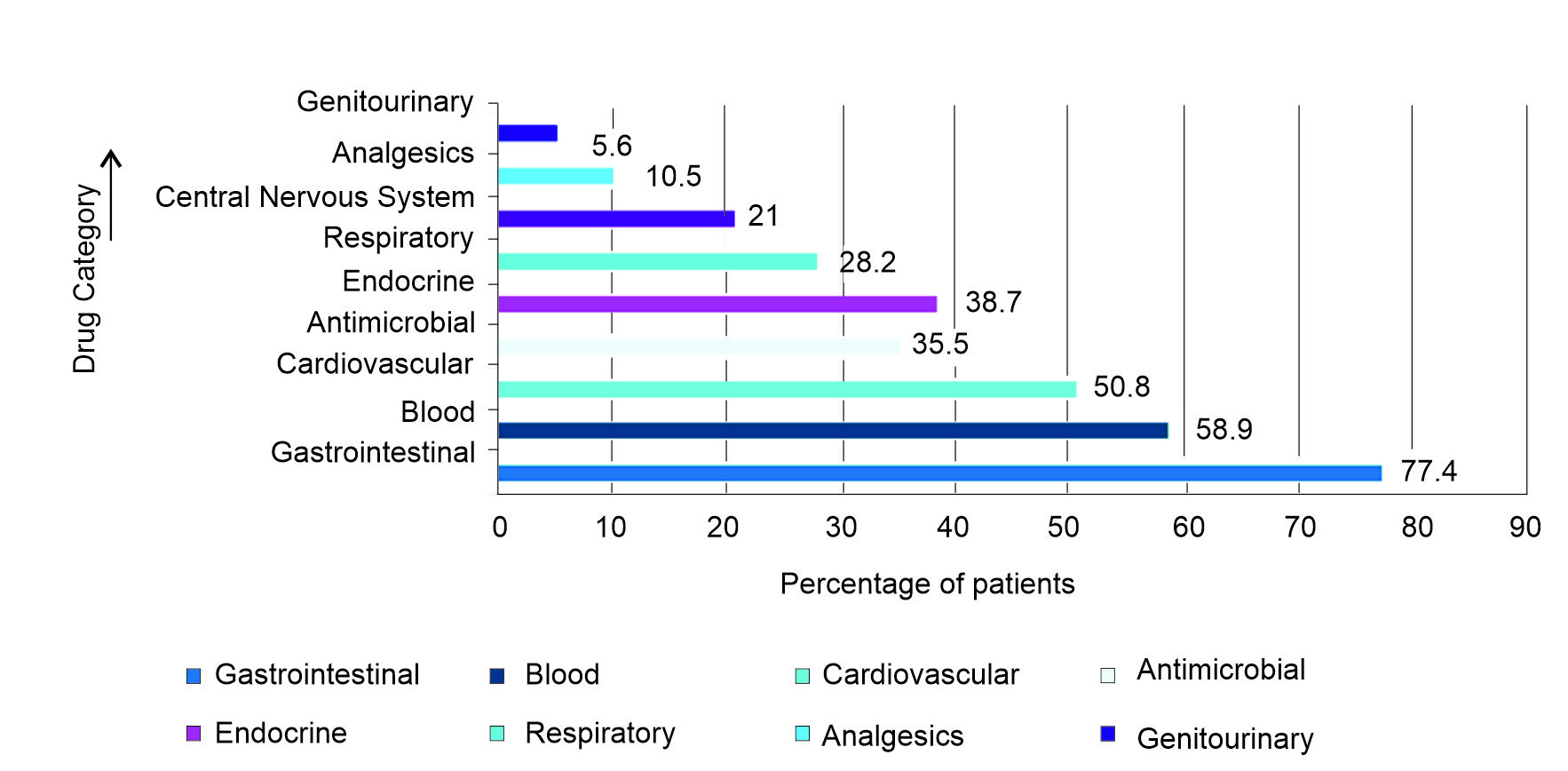
A total of 995 drugs were prescribed for 124 patients. The average drugs prescribed per patient was 8.02 ± 3.01. The number of drugs prescribed in each prescription ranged from 2–16. Fourteen (11.29%) of the prescriptions had 1–4 drugs, 68 (55%) had 5–9 drugs, 40 (32.2%) had 10–14 drugs and 2 (1.61%) had 15–19 drugs. The major categories of drugs in the prescriptions were drugs acting on gastrointestinal (GI) system 96 (77.4%) followed by the those acting on blood and cardiovascular system as shown in Figure 1. The proton pump inhibitors were the most common group 56 (45.2%) prescribed amongst the GI drugs. Amongst the 47 antihypertensives prescribed, 34 were Angiotensin Converting Enzyme inhibitors followed by 10 calcium channel blockers and 3 beta blockers. The most preferred group of antimicrobial agents were the beta lactam antibiotics 29 (23.4%). Vitamins were prescribed in 52 (41.9%), 11 (8.9%) were supplemented with electrolytes, 37 (29.8%) were on intravenous fluids and 5 (4%) required blood transfusions.
One hundred and nineteen (96%) patients were prescribed parenteral drugs, 117 (94.4%) oral, 44 (35.5%) inhalational drugs and 2 (1.6%) topical. Out of the 124 prescriptions, 43 (53.32%) prescriptions with potentially inappropriate medications (PIM) were detected using the Beers criteria as summarized in Table 1.
|
S. No |
Name of the drug |
Frequency |
Recommendations |
|---|---|---|---|
|
1 2 3 |
Lorazepam Clonazepam Alprazolam |
6 2 1 |
Avoid Benzodiazepines (BZD), because it increases risk of cognitive impairment, delirium, falls, fractures, and motor vehicle accidents in elderly. |
|
4 |
Spironolactone |
5 |
It causes hyperkalaemia in heart patients if taken greater than 25mg/day. |
|
5 |
Aspirin |
1 |
Use with caution in adults > 80 years old. Lack of evidence of benefit versus risk in such individuals. |
|
6 |
Digoxin |
2 |
Avoid as first-line therapy for heart failure. |
|
7 |
Nitrofurantoin |
2 |
Avoid in individuals with Creatinine Clearance < 30mL/min or long-term suppression: Potential for pulmonary toxicity, hepatotoxicity, and peripheral neuropathy, especially with long-term use. |
|
8 |
Insulin |
19 |
Avoid; higher risk of hypoglycaemia without improvement in hyperglycaemia management regardless of care setting. |
|
9 |
Sulfonylureas |
3 |
Avoid; chlorpropamide: Long half-life and can cause prolonged hypoglycaemia and SIADH; glimepiride and glyburide: higher risk of severe prolonged hypoglycaemia |
|
10 |
Trihexyphenidyl |
1 |
Avoid as more effective anti-Parkinson's agents available. |
|
11 |
Prazosin |
1 |
Avoid prazosin as it increases risk of orthostatic hypotension or bradycardia. |
4. Discussion
This study comprehensively evaluated the prescription pattern in the elderly and estimated the proportion of PIM along with its description using the Beers criteria. Consistent with the findings of Bhaveshaikh et al., as well as Goudanavar P et al., the majority of the participants were in the 65–70 years age group.[9][10] Veena et al., observed that cardiovascular diseases and respiratory diseases were the most common reasons for hospital admission among elderly which is in concurrence with this study.[11] GI protective agents were the most commonly prescribed medications in our study. It was prescribed along with majority of the cardiovascular and antimicrobial drugs to prevent GI adverse effects.
The incidence of comorbidities is higher in the elderly. Among those 65 years and older in the United States, approximately 60% have at least two chronic conditions and 25% have at least four.[12] It was observed that about 37% patients had multiple diagnosis at admission. This shows that multiple systems are being targeted while prescribing to the elderly which could lead to polypharmacy and drug interactions. Elderly has been considered as a surrogate of comorbidity and expected end of life in evidence-based literature as the risk or prevalence of certain disease escalates with increasing age.[3]
The World Health Organization (WHO) says that polypharmacy is the concurrent use of multiple medications usually five which includes prescription, over the counter drugs, traditional as well as complementary medicines.[6][13] While it is advisable to keep the number of drugs per prescription as low as possible, the goal is to curb inappropriate polypharmacy which is irrational and to ensure appropriate polypharmacy based on evidence and patient characteristics.[13] By ensuring appropriate polypharmacy at the initiation of new treatment and transition across different health care setting, unwarranted drug interactions and adverse effects can be prevented. In a study conducted by Joshi et al, in a hospital in Nepal the incidence of polypharmacy in geriatric population was found to be 73%.[14] In this study, the average drugs prescribed per patient was 8.02 ± 3.01. Indian studies elsewhere have found an average drugs per encounter of 4.79, 5.51, 7.37, however Brazilian and Nigerian studies showed 3.8 and 3.9 drugs respectively.[9][15][16][17][18]
Potentially inappropriate medication (PIM) is defined as "a drug in which the risk of an adverse event outweighs its clinical benefit, particularly when there is a safer or more effective alternate therapy for the same condition".[19] Prescription of potentially inappropriate medications, polypharmacy and drug interactions are major therapeutic issues identified in the study. Prescribing patterns of drugs reflects the clinical judgement of the clinicians. The medications in Beers criteria are divided into three categories: Potentially inappropriate medications or classes to avoid in older adults, potentially inappropriate medications or classes to avoid in older adults with certain diseases, and syndromes that the drugs listed can exacerbate, and medications to be used with caution in older adults.[20] In this study, 43 cases of potentially inappropriate prescriptions were found. These drugs did not cause any adverse reactions in the patients, but it as per the Beers criteria it is safer to avoid usage of such high-risk drugs in the elderly. Studies done in India have estimated PIM as 32.19% and 35.5% as per Beers criteria for PIMs.[19][21] Prospective observational studies done outside India, have estimated PIMS as 34.5% in Brazil, atleast one PIM in 25.5% in Nigeria, while a Chilean study identified 32% one PIM, 20% two PIMs and 48% more than two PIMs.[22][23][24] Das et al., found that the most commonly identified PIMs included long-term use of benzodiazepines (69.4%) followed by prolonged use of proton pump inhibitors without appropriate indications (56.6%).[6] In this study 8 out of 43(18.6%) PIMs identified were of benzodiazepines. Clinico pharmacological reconciliation, patient centered deprescribing and medication reviews in collaboration with caregivers can help in curbing potentially in appropriate medications, thus decreasing the morbidity associated with it.
The limitations of this study include retrospective review of case sheets which adds to the literature but lacks immediate benefit to the patients. Prospective multicentric studies with larger sample size along with prescription audits and medication reconciliation would further provide better insights in this area. Only Beer’s criteria were used, inclusion of additional tools like STOPP/START criteria could have strengthened the findings. The clinical outcomes related to PIMs were not assessed.
5. Conclusion
Cardiovascular diseases were the most common reason for admission. The most widely prescribed groups of drugs were related to the gastrointestinal and cardiovascular system. Potentially inappropriate prescriptions identified using the Beer’s criteria in the elderly warrants extra caution while prescribing in geriatric patients. Proper deprescription habits with rational drug use and regular medication review can ensure better safety among the geriatric population.
6. Authors Contributions
Sujatha Mangattuvalappil Balakrishnan: Conceptualization, methodology, Supervision, Validation. Dona Maria Kurian: Data curation, formal analysis, methodology, resources, writing – review editing. Swathi Premchand: Data curation, methodology, project administration, validation, writing – original draft. Preetha Jose: Conceptualization, writing – review editing.
7. Source of Funding
None.
8. Conflict of Interest
None.
9. Ethical Approval
The study was approved by the Institutional Ethics Committee of Govt. Medical Medical College, Thrissur, Kerala (Ref. No. IEC155/2019/MCTCR(8)).
10. Acknowledgement
We thank the support and suggestions of Dr. M A Andrews and Dr. S P Dhanya for their support in this study.
References
- Kundu S, Dhillon P. Applications of new measures of population ageing using quantity and quality of remaining life years to India and selected states. J Biosoc Sci. 2023;55(4):608-26. [Google Scholar] [Crossref]
- . . . 2024. [Google Scholar]
- Singh S, Bajorek B. Defining 'elderly' in clinical practice guidelines for pharmacotherapy. Pharm Pract (Granada). 2014;12(4). [Google Scholar] [Crossref]
- Truijen S, Schreurs J, Boonen A vOM. The operational definition of old age and impact on outcomes in DMARD-treated patients with rheumatoid arthritis: A systematic literature review. Semin Arthritis Rheum. 2025;71. [Google Scholar] [Crossref]
- Drenth-van Maanen A, Wilting I, Jansen P. Prescribing medicines to older people-How to consider the impact of ageing on human organ and body functions. Br J Clin Pharmacol. 2020;86(10):1921-30. [Google Scholar] [Crossref]
- Das S, Gnanavel P, Smanla S, Saikia A, Mishra S, Khare SPasaoaiIuccs. 2025;15(1):4062. Sci Rep. 2025;15(1). [Google Scholar] [Crossref]
- American GS2BCUEP. . . 2023. [Google Scholar]
- O'Mahony D, Cherubini A, Guiteras A, Denkinger M, Beuscart J, Onder G. STOPP/START criteria for potentially inappropriate prescribing in older people: version 3. Eur Geriatr Med. 2023;14(4):625-32. [Google Scholar] [Crossref]
- Bhaveshaikh N, Sukumaran S, Vyas U. Drug prescribing patterns in elderly patients in a tertiary level hospital. Int J Basic Clin Pharmacol. 2017;6(4):759-64. [Google Scholar] [Crossref]
- Goudanavar P, Keerthi Y, John S, Jacob J, Krishna M. A Prospective Study on Medication Prescribing Pattern for Geriatric Patients in a Tertiary Care Teaching Hospital. Asian J Biomed Pharm Sci. 2016;6(56):23-7. [Google Scholar] [Crossref]
- Veena D, Padma L, Patil S. Drug prescribing pattern in elderly patients in a teaching hospital. IOSR J Dent Med Sci. 2012;1(5):39-42. [Google Scholar] [Crossref]
- Ouellet G, Ouellet J, Tinetti M. Principle of rational prescribing and deprescribing in older adults with multiple chronic conditions. Ther Adv Drug Saf. 2018;9(11):639-52. [Google Scholar] [Crossref]
- . Medication Safety in Polypharmacy. Geneva: World Health Organization. 2019. [Google Scholar]
- Upadhyay J, Joshi Y. Observation of drug utilization pattern and prevalence of diseases in elderly patients through home medication review. Asian J Pharm Clin Res. 2011;4(1):143-5. [Google Scholar]
- Kumar R, Bhat N, Kumar D, Gupta S. Drug Prescribing Pattern in Elderly Patients Admitted in Medicine Department of a Tertiary Care Teaching Hospital in North India-A Prescription Evaluation Study. J Med Educ Res. 2018;19(4):233-7. [Google Scholar]
- Sharma N, Advani U, Kulshreshtha S, Parakh R, Bansal A, Sinha R. Screening of prescription in geriatric population in a tertiary care teaching hospital in north India. J Phytopharmacol. 2013;2(5):38-45. [Google Scholar] [Crossref]
- Faggiani F, Schroeter G, Pacheco S, De Souza A, Werlang MC ADCG. Profile of drug utilization in the elderly living in Porto Alegre, Brazil. Pharm Pract (Granada). 2007;5(4):179-84. [Google Scholar] [Crossref]
- Eze U, Olowu A. Prescribing patterns and appropriate use of medication in elderly outpatients in a tertiary care hospital in Nigeria. Trop J Pharm Res. 2011;10(1). [Google Scholar] [Crossref]
- Chitra B. Senthilvel N, Sowmya R, Sathyan S and Srisha R: A Study on Prescribing Pattern of Drugs in Geriatrics Using Beers Criteria at a Private Corporate Hospital. Int J Pharm Sci Res. 2015;6(11):4810-25. [Google Scholar] [Crossref]
- de Oliveira Alves C SF, Trevisol D. Beers criteria-based assessment of medication use in hospitalized elderly patients in southern Brazil. J Family Med Prim Care. 2014;3(3):260-5. [Google Scholar] [Crossref]
- Abraham F, Varughese G, Mathew J, John P, Sam G. Drug Utilization Pattern Among Geriatric Patients In A Tertiary Care Teaching Hospital. Asian J Pharm Clin Res. 2015. [Google Scholar]
- Oliveira M, Amorim WW dJS, Rodrigues V, Passos L. Factors associated with potentially inappropriate medication use by the elderly in the Brazilian primary care setting. Int J Clin Pharm. 2012;34(4):626-32. [Google Scholar] [Crossref]
- Fadare J, Agboola S, Opeke O, Alabi R. Prescription pattern and prevalence of potentially inappropriate medications among elderly patients in a Nigerian rural tertiary hospital. Ther Clin Risk Manag. 2013;9:115-20. [Google Scholar] [Crossref]
- Arellano C, Saldivia G, Cordova P, Fernandez P, Morales F, Lopez M. Using two tools to identify potentially inappropriate medications (PIM) in elderly patients in Southern Chile. Arch Gerontol Geriatr. 2016;67:139-44. [Google Scholar] [Crossref]
Article Metrics
- Visibility 49 Views
- Downloads 23 Views
- DOI 10.18231/j.ijpp.17503.1784627031
-
CrossMark

- Citation
- Received Date May 19, 2026
- Accepted Date July 14, 2026
- Publication Date August 03, 2026