Indian Journal of Pharmacy and Pharmacology
Indian Journal of Pharmacy and Pharmacology (IJPP) is an open-access, peer-reviewed pharmacy journal, published quarterly, as print and online by the Innovative Education and Scientific Research Foundation (IESRF) since 2014. we will be publishing articles ‘Ahead of Print’ immediately upon acceptance of manuscript. In addition, the journal allows free access (Open Access) to its contents, which is likely to attract more readers and citations to articles published in journal.Manuscripts should be prepared in accordance with the author guidelines of the journal, which follow the recommendations...
Exploring the role of ranolazine and levosimendan as anxiolytic and anti-depressant in behavior models of wistar rats

Abstract
Introduction: Neuropsychiatric disorders, particularly anxiety and major depressive disorder, share extensive pathophysiological overlaps with chronic cardiovascular diseases, including profound neuroinflammation, oxidative stress, and compromised neuroplasticity. Consequently, repurposing established cardiovascular drugs that exhibit pleiotropic neuroprotective properties represents a highly promising pharmacological strategy. This study aimed to comparatively analyze the anxiolytic and antidepressant-like effects of two distinct cardiovascular agents, ranolazine (a late sodium current inhibitor) and levosimendan (a calcium sensitizer and potassium channel opener), in validated preclinical behavioral models.
Methods: Healthy adult female Wistar rats (130–200g, 18–20 weeks old) were randomized into respective experimental groups (n = 6 per group). The anxiolytic effects were evaluated using the Elevated Plus Maze (EPM) over a 5-day administration period, comparing ranolazine (90mg/kg) and levosimendan (12ug/kg) against a normal saline control and standard diazepam (1mg/kg). The antidepressant effects were evaluated utilizing the Tail Suspension Test (TST) over a 30-day administration period, comparing the same test drugs against a standard imipramine control (10mg/kg). Comprehensive statistical analyses were conducted utilizing one-way ANOVA followed by Tukey's post-hoc test, as well as paired t-tests for within-group assessments.
Results: In the Elevated Plus Maze, both ranolazine and levosimendan generated substantial anxiolytic effects by Day 5, significantly increasing the frequency of open arm entries and the total duration spent in the open arms compared to their respective baselines, demonstrating efficacy that paralleled the standard diazepam intervention. In the Tail Suspension Test, unmedicated control animals exhibited a severe, progressive increase in immobility time by Day 46, reflecting learned helplessness resulting in behavioral despair. Ranolazine treatment completely arrested this decline and produced a statistically dominant reduction in immobility time. Conversely, levosimendan demonstrated significantly weaker and highly inconsistent antidepressant-like effects throughout the prolonged timeline.
Conclusion: Ranolazine exhibits potent, broad-spectrum neuropsychopharmacological benefits, acting as both a robust anxiolytic and a highly superior antidepressant-like agent. Levosimendan provides significant anxiolytic benefits but lacks durable efficacy in behavioral models of depression. These profound findings strongly advocate for the targeted clinical repurposing of ranolazine in vulnerable patient populations suffering from comorbid cardiovascular and psychiatric dysfunction.
1. Introduction
Cognitive impairment and severe psychiatric deterioration have long been recognized as profound determinants in the long-term prognosis and overall therapeutic outcomes of multiple chronic disorders. Prevalence of psychiatric disorders like depression and anxiety is estimated to be around 332 million globally as per WHO reports.[1] Cardiovascular diseases, in particular, are vastly prevalent and have been consistently and intricately associated with cognitive and psychiatric decline.[2][3] Debilitating psychiatric conditions, encompassing a broad spectrum of clinical depression, pervasive anxiety, frequently present as adverse, long-term outcomes of congestive heart failure.[4] Anxiety, which frequently co-occurs as part of the broader spectrum of depressive episodes, also extends as an isolated and debilitating symptom in various primary psychiatric disorders.
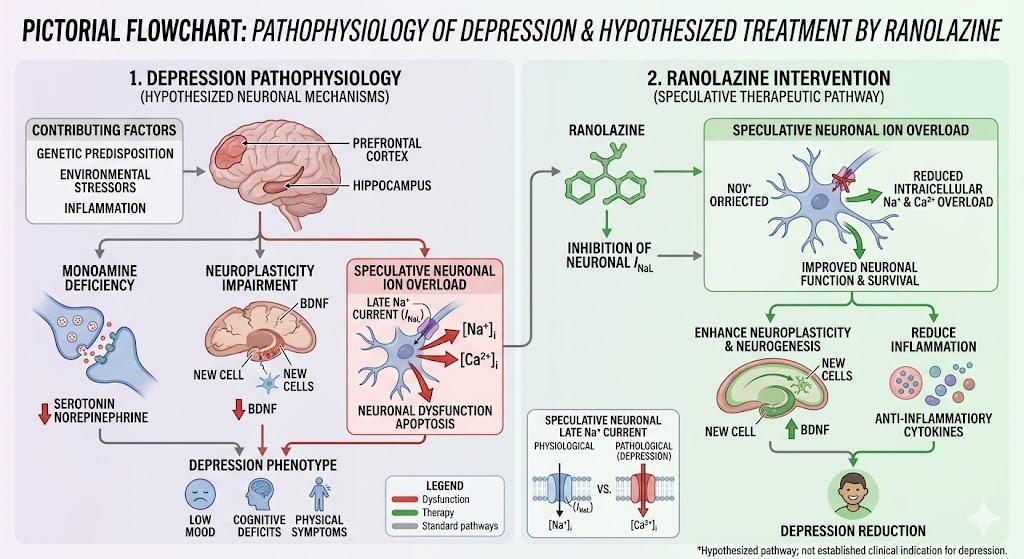
The link between clinical depression, severe anxiety is mediated through a highly complex pathological pathways, primarily including chronic neuroinflammation, oxidative stress, glutamate-mediated excitotoxicity, and profound dysregulation of the hypothalamic-pituitary-adrenal (HPA) axis. According to the Diagnostic and Statistical Manual of Mental Disorders, Fifth Edition (DSM-5), major depressive disorder is a pervasive mood disorder characterized by persistent sadness, emptiness, or an irritable mood, accompanied by somatic and cognitive changes that severely impair an individual's functional capacity.[5] The fundamental pathophysiology points to a complex interplay between neurotransmitter availability, specifically serotonin, norepinephrine, dopamine, and glutamate, alongside severe deficiencies in brain-derived neurotrophic factor (BDNF) ([Figure 3]).
Similarly, pathological anxiety represents a future-oriented mood state resulting from an exaggerated perception of threat, initiating an inappropriate fight-or-flight response mediated heavily by the amygdala and interconnected prefrontal-limbic activation patterns. The pathophysiology originates from cardiac insults that trigger the chronic activation of the sympathetic nervous system and the renin-angiotensin-aldosterone system (RAAS), precipitating systemic vasoconstriction, pathological sodium retention, and cellular apoptosis. This metabolic failure translates systemically; the resulting chronic cerebral hypoperfusion severely impairs autoregulation, fosters proteotoxicity from widespread protein misfolding, and drastically increases systemic inflammation, all of which permeate the blood-brain barrier to manifest as severe psychiatric impairments and cognitive decline.
Within this complex pathophysiological framework, the deployment of novel or repurposed cardiovascular therapeutics that exhibit distinct neuroprotective actions represents a highly promising candidate strategy. Neuroprotective strategies inherently aim to preserve neuronal structure and function by aggressively modulating oxidative stress, suppressing pro-inflammatory pathways, and augmenting neurotrophic support systems. Several drugs, notably ranolazine and levosimendan, have recently demonstrated considerable promise in this exact context due to their well-documented pleiotropic antioxidant, anti-inflammatory, and pro-neuroplastic effects.[6][7] This evolving therapeutic paradigm emphasizes the critical importance of investigating pharmacological agents that possess dual cardioprotective and neuroprotective roles, particularly in clinical scenarios where depression, anxiety, and heart failure inextricably coexist.[8]
Ranolazine an anti-anginal agent, exerts its principal mechanism of action through the precise inhibition of the late sodium current in cardiac myocytes, thereby significantly reducing intracellular sodium accumulation and subsequent destructive calcium overload.[9] Because of the close physiological relationship between cardiovascular and central nervous system functions, ranolazine has shown highly promising neuroprotective properties across multiple preclinical models. By interacting with the inactivated states of brain sodium channels, particularly the NaV1.1, NaV1.7, and NaV1.8 isoforms, ranolazine safely decreases the frequency of action potential firing in hyperactive hippocampal neurons.[10] Crucially, ranolazine has been shown to rapidly upregulate brain-derived neurotrophic factor (BDNF) and drastically reduce the expression of pro-inflammatory cytokines such as IL-1beta and IL-6. Its indirect modulation of critical serotonin and dopamine pathways further suggests massive potential applications in psychiatric conditions such as clinical depression and generalized anxiety.[11]
Levosimendan, functions distinctly as an inotropic and vasodilatory agent primarily indicated for the acute management of decompensated heart failure. It acts as a highly specific calcium sensitizer by binding directly to cardiac troponin C and simultaneously acting as an ATP-sensitive potassium channel opener, levosimendan powerfully enhances myocardial contractility while simultaneously reducing vascular afterload without increasing myocardial oxygen demand. By maintaining physiological calcium levels essential for standard neurotransmitter release and preventing pathological calcium overload, levosimendan successfully preserves synaptic remodeling and prevents neuronal death. In preclinical neuroprotective contexts, it has successfully mitigated neuroinflammation and enhanced BDNF levels through the modulation of the pCREB/BDNF signaling pathway.[7]
Despite the proven individual efficacies of ranolazine and levosimendan regarding broad neuroprotection, significant scientific gaps persist in the existing literature. Comprehensive studies simultaneously comparing both drugs across multiple behavioral disease models remain exceptionally scarce. The primary aim of the present experimental study is to systematically explore, comprehensively evaluate, and directly compare the anxiolytic and anti-depressant effects of ranolazine and levosimendan. The study aims to explore the potential for repurposing of drugs for the treatment of psychiatric disorders.
2. Materials and Methods
The entire experimental protocol was meticulously designed and formally conducted within the Department of Pharmacology & Therapeutics at King George's Medical University, Lucknow, Uttar Pradesh, India. Complete ethical approval was officially obtained from the Institutional Animal Ethics Committee (IAEC) prior to the commencement of any live animal interventions (Ref. No.-191/IAEC/2024). The full execution of the research study spanned a total duration of twelve months. All animal care, handling, and experimental procedures were executed in accordance with the guidelines by the Committee for Control and Supervision of Experiments on Animals (CCSEA).
The study was done on adult healthy Wistar rats exclusively of the female sex to maintain hormonal and biological consistency across the behavioral models. The animal subjects were aged between 18 and 20 weeks at the formal onset of the experimental interventions. The subjects were officially procured from a CCSEA-certified animal breeding facility.
Upon arrival at the testing site, the rats were housed securely in the institutional animal facility under a strictly temperature-controlled environment mechanically maintained at 25 ± 2°C. The housing facility featured a fully standardized 12-hour light and 12-hour dark circadian cycle. The Wistar rats were provided with continuous ad-libitum access to a normal pellet diet and water. A mandatory two-week acclimatization period was enforced prior to any experimentation.
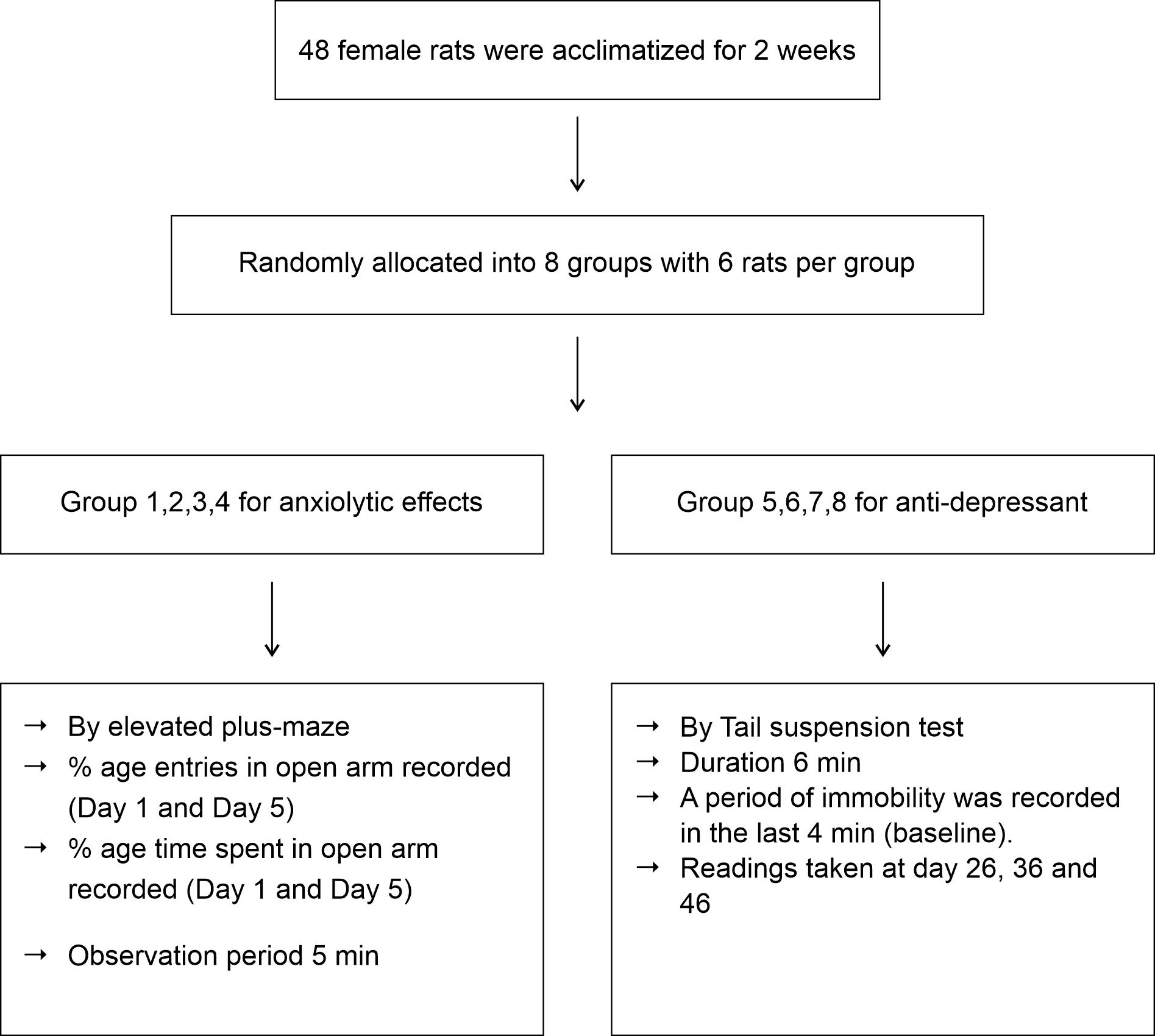
A total of 48 female Wistar rats were randomly allocated through simple randomization into 8 specific treatment groups. Each discrete experimental group comprised exactly 6 rats (n = 6) to ensure statistical validity. The doses administered were 90mg/kg for ranolazine[11] and 12µg/kg for levosimendan[7][12]. The standard drug was diazepam 1mg/kg for EPM[13] and imipramine 10mg/kg for anti-depressant effects by TST.[14] The drugs were given through intraperitoneal route and vehicle used was 0.9% normal saline.
2.1. Study of anxiolytic effects by using elevated plus maze
24 rats were divided into 4 groups with 6 rats per group. Group 1 acted as the control, receiving 1ml of 0.9% normal saline daily. Group 2 served as the standard, receiving Diazepam (1mg/kg). Group 3 received the experimental treatment Ranolazine (90mg/kg), and Group 4 received the experimental treatment Levosimendan (12ug/kg). All respective treatments were administered intra-peritoneally daily for a total of 5 consecutive days. Individual rats were carefully placed in the neutral center of the maze and permitted to freely explore both the open and closed arms for a continuous 5-minute observation period. The total number of separate entries into the open arms and the total cumulative time spent in the open arms were recorded on Day 1 and Day 5 of the experiment.
2.2. Study of anti-depressant effects by using tail suspension test
24 rats were divided randomly into 6 per group into 4 groups. Group 1 acted as the control, receiving 1ml of 0.9% normal saline daily. Group 2 served as the standard, receiving imipramine (10mg/kg). Group 3 received the experimental treatment Ranolazine (90mg/kg), and Group 4 received the experimental treatment Levosimendan (12ug/kg). All respective treatments were administered intra-peritoneally daily for a total of 30 consecutive days. Each rat was safely suspended by their tails using a Tail Suspension Apparatus for a total strict observation time of 6 minutes.[15] A rat was strictly considered entirely immobile only when it hung passively and remained completely motionless for at least 1 continuous minute. To establish a completely consistent baseline of despair and avoid immediate struggle artifacts, the total time of immobility was recorded exclusively during the final 4 minutes of the behavioral test. Quantitative readings were systematically captured on Day 26, Day 36, and Day 46 of the experiment.
Upon the complete and final conclusion of all specified behavioral experimental timelines, the animal subjects were humanely sacrificed using a painless, phenobarbitone administered at a dose of 40mg/kg of body weight via the intraperitoneal route. The proper, sanitary disposal of all animal carcasses was subsequently executed in strict adherence to institutional Bio-Medical Waste (BMW) management guidelines.
2.3. Statistical analysis
Observed data was expressed in Mean ± SD, and was analyzed using ANOVA followed by post-hoc Tukey test. Paired-t test was applied for within the group comparison and p value < 0.05 is considered significant for all results. The software used was SPSS version 24.
3. Results
3.1. Anti-anxiety effects
On Day 1, observations were remarkably consistent across the control and all treatment groups. The mean open arm entries were identical for the Control, Standard (Diazepam), and Ranolazine groups, and slightly lower for the Levosimendan group, yielding a non-significant p-value of 0.914. Similarly, the total time spent in the open arm on Day 1 varied non-significantly (p = 0.856) across treatment groups. By Day 5, however, open arm entries diverged significantly. While the Control group remained low, the treatment groups showed surge in open arm entries, and generated a highly significant p-value of 0.007. The time spent in the open arm on Day 5 followed an ascending trend as well. As per Post-hoc Tukey test, there were zero significant differences between any groups on Day 1 (p > 0.05). On Day 5, the significant open arm entries were observed between the Control and Standard groups (p = 0.005) ([Table 1], [Table 2]).
In the Elevated Plus Maze test, Control animals showed minimal changes in anxiety-like behavior, Standard treatment produced marked anxiolytic effects, with open arm entries and time spent in open arms increasing significantly (p < 0.05) showing the largest improvement among all groups. Ranolazine treatment led to significant increases in open arm entries and time spent (p < 0.05), indicating substantial anxiety reduction. Levosimendan also improved anxiolytic behavior (p < 0.05). Overall, Standard and Levosimendan treatments showed the most significant anxiolytic effects, followed by Ranolazine, while Control animals exhibited minimal changes
3.2. Anti-depressant effects
On Day 26, the immobility times were statistically insignificant, across all groups. By Day 46, the Control group registered an increased immobility duration, while the treatment groups showed lower immobility time, yielding a p-value of < 0.001. Using the Post-hoc Tukey HSD test, On Day 36, the Control group was significantly more immobile than all therapeutic groups. Day 46, the Control group's total immobility was profoundly higher than the Standard group (p < 0.001). Ranolazine showed decreased immobility than the Control baseline with a mean difference of 67.50 seconds (p < 0.001). Furthermore, Ranolazine compared to Levosimendan, displayed a mean difference of (p < 0.001), thereby showing better anti-depressant action ([Table 3], [Table 4]).
|
Parameters Evaluated |
Mean ± SD |
|---|---|
|
Open arm entry day 1 |
1.29 ± 0.46 |
|
Time spent in open arm day 1 |
86.96 ± 28.04 |
|
Open arm entry day 5 |
2.21 ± 0.66 |
|
Time spent in open arm day 5 |
132.33 ± 26.77 |
|
Parameters evaluated |
Groups |
p-value |
|||
|---|---|---|---|---|---|
|
Control |
Standard |
Ranolazine |
Levosimendan |
||
|
Mean ± SD |
Mean ± SD |
Mean ± SD |
Mean ± SD |
||
|
Open arm entry Day 1 |
1.33 ± 0.52 |
1.33 ± 0.52 |
1.33 ± 0.52 |
1.17 ± 0.41 |
0.914 |
|
Time spent in open arm Day 1 |
90.33 ± 40.21 |
82.33 ± 20.14 |
93.83 ± 31.49 |
81.33 ± 21.68 |
0.856 |
|
Open arm entry Day 5 |
1.50 ± 0.55 |
2.67 ± 0.52 |
2.33 ± 0.52 |
2.33 ± 0.52 |
0.007 |
|
Time spent in open arm Day 5 |
109.00 ± 38.63 |
145.83 ± 8.26 |
142.33 ± 20.53 |
132.17 ± 17.96 |
0.062 |
|
Parameter evaluated |
Mean ± SD |
|---|---|
|
Time of Immobility Day 26 |
172.71 ± 9.56 |
|
Time of Immobility Day 36 |
174.58 ± 13.42 |
|
Time of Immobility Day 46 |
178.88 ± 28.02 |
|
Parameter evaluated |
Groups |
p-value |
|||
|---|---|---|---|---|---|
|
Control |
Standard |
Ranolazine |
Levosimendan |
||
|
Mean ± SD |
Mean ± SD |
Mean ± SD |
Mean ± SD |
||
|
Time of Immobility Day 26 |
171.17 ± 11.18 |
177.67 ± 7.09 |
173.33 ± 9.22 |
168.67 ± 10.39 |
0.436 |
|
Time of Immobility Day 36 |
190.83 ± 12.37 |
170.67 ± 6.68 |
163.17 ± 8.08 |
173.67 ± 8.55 |
< 0.001 |
|
Time of Immobility Day 46 |
219.00 ± 11.44 |
161.33 ± 4.72 |
151.50 ± 8.12 |
183.67 ± 12.80 |
< 0.001 |
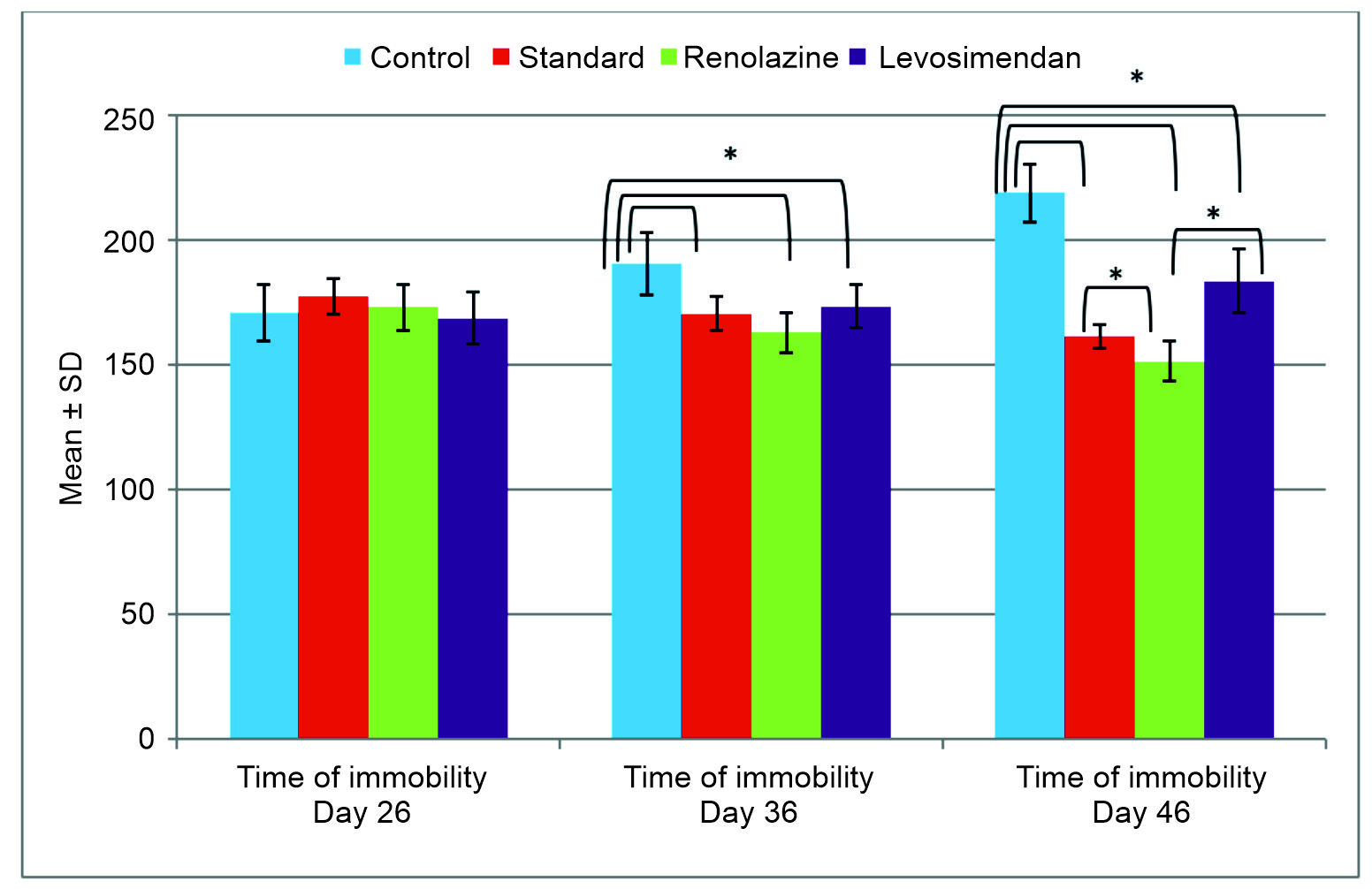
Ranolazine showed better antidepressant-like action in TST. From Day 26 to Day 46, Ranolazine reduced mean immobility (p < 0.001). Levosimendan, from Day 26 to Day 46, its immobility actually increased slightly (p = 0.001), indicating that while it performed significantly better than the control group, it failed to elicit a antidepressant reversal comparable to Ranolazine or the standard Imipramine ([Figure 2]).
4. Discussion
This study was executed to evaluate the effects of ranolazine and levosimendan within neuro-psychiatric domains, utilizing validated behavioral tests in female Wistar rats. The trends explicitly observed in the Elevated Plus Maze performance are profoundly consistent with reports previously described in literature by Pellow et al., where behavioral shifts accurately reflect the gradual reduction of novelty-induced anxiety over sustained timeline.[16] Concurrently, the Tail Suspension Test was employed to observe subtle, long-term deviations in anti-depressant efficacy and behavioral despair.
The Elevated Plus Maze observations revealed no baseline differences in anxiety-like behavior across the groups on Day 1, confirming a comparable initial cognitive status across the entire study population. By the Day 5, all pharmacologically treated groups exhibited a pronounced, highly significant increase in open arm exploration, definitively establishing clear, undeniable anxiolytic effects across the groups. The standard Diazepam, produced the strongest anxiolytic response, doubling the raw number of open arm entries (an approximate 100% quantitative increase) and the total time spent in the open arms by roughly 75%. Both levosimendan and ranolazine demonstrated remarkable, highly robust anxiolytic-like effects of their own, generating quantitative increases in open arm dwell time of approximately 60% and 50%, respectively. Although the absolute increases observed specifically with ranolazine and levosimendan did not consistently reach the statistical significance observed with Diazepam. Therefore, the marked anxiolytic effects by both drugs strongly supports their innate role in possible attenuating of hyper-aroused limbic networks without relying on direct, potentially sedating GABAergic depression. The neuroprotective properties of ranolazine are well supported in heart diseases patients as well.[17] The results are supported by studies involving ranolazine pharmacological moiety leading to anti-anxiety effects in rodents.[18][19]
Within the observations of Tail Suspension Test, this study meticulously documented a slow, gradual increase in total immobility time among the control animals across the entirety of the prolonged experimental timeline. This overall pathological rise of approximately 25–30% perfectly maps the organic physiological onset and progressive development of a deep depressive-like behavioral phenotype. Comparable, identical increases in total immobility time have been documented in classical chronic stress and widespread behavioral despair models pioneered by Cryan et al. and Steru et al.[20][21]
Ranolazine produced most significant reduction in overall immobility time, approximately 12–13% by the conclusion of Day 46 relative to its own starting baseline. This can be attributed likely to ranolazine's ability to modulate the late sodium current within hyperactive neurons, fundamentally improving mitochondrial energy efficiency and drastically slashing excessive neuronal energy demand. This leads to the synthesis of BDNF and the targeted, aggressive suppression of neuroinflammation.
The post-hoc statistical analysis observed that ranolazine was significantly better anti-depressant as it maintained drastically lower total immobility times compared against both the Standard Imipramine group and the Levosimendan group by Day 46. In contrast, levosimendan exhibited a weaker and inconsistent antidepressant-like profile. The overall reductions in immobility observed with levosimendan were low magnitude and highly variable over the extended timeline. The extensive literature findings strongly suggest that levosimendan predominantly exerts its physiological effects strictly as a broad neuroprotective and metabolic barrier against acute ischemic damage, rather than acting as a direct mood-modulating agent within completely non-ischemic, purely psychological behavioral despair models. The neuroprotective and cognitive effects of ranolazine have been supported by studies in metabolic models also validated by estimation of biomarkers.[22][23]
One of the primary strengths of this study lies within its utilization of entirely non-chemical, psychologically-driven behavioral models (such as inescapable suspension stress) to isolate the innate anxiolytic and antidepressant capabilities of these drugs. A limitation, however, is that this specific lack of induced ischemia means that the findings represent the drugs' effects on baseline healthy tissue subjected solely to psychological distress, which may inherently underrepresent levosimendan extreme efficacy typically seen under hypoxic conditions. Additionally, testing was restricted to a single sex, warranting future parallel studies. Limitations of study included shorter study duration and lack of biomarker estimation for better support to the role of ranolazine as psychiatric modulator.
5. Conclusion
This study aimed to study the anxiolytic and anti-depressant effects of ranolazine and levosimendan in Wistar rats using EPM and TST, compared to standard treatment drugs. In the Elevated Plus Maze test, all therapeutic interventions were found to reduce inherent anxiety-like behavior by the Day 5. While the standard Diazepam treatment predictably produced the most significant anxiolytic response, both Levosimendan and Ranolazine demonstrated anti-anxiety potential though not significant statistically.
Within the Tail Suspension Test, the Control animals exhibited a progressive increase in total immobility time scaling up to 30%, reflecting the organic physiological development of clinical depressive-like behavior and deeply ingrained behavioral despair. While all treatment groups attenuated the immobility time, Ranolazine produced the most statistically significant antidepressant-like effect, showing nearly 13% internal reduction. Levosimendan, demonstrated significantly weaker and highly inconsistent antidepressant effects over the extended testing timeline.
In final conclusion, Ranolazine offers the most consistent, potential as an antidepressant-like compound. However further researches are needed to reaffirm the finding of the study. Potential of ranolazine if explored further and proven effective as well could change the course of future neuro-psychiatric pathologies associated with cardiovascular disorders.
6. Authors Contribution
Pragya Pande: Data curation, investigation, methodology, project administration, supervision. Shoebul Haque: Investigation, supervision. Bablu Bhargava: Conceptualization, resources. Rishi Pal: Formal analysis. Rajendra Nath: Formal analysis. Rakesh Kumar Dixit: Data curation, writing – review editing.
7. Source of Funding
None.
8. Conflict of Interest
None.
9. Ethical Approval
The study was approved by the Institutional Ethics Committee of KGMU, King George's Medical University, U.P. Lucknow (Ref. No.-191/IAEC/2024).
References
- . Depressive disorder (depression) [Internet]. [29 August. 2025. [Google Scholar]
- Bolaji O, Bahar Y, Lohana S, Bahar A, Lawrence I, Mazimba S. The heart–brain axis: neurocognitive frailty in heart failure. J Neurol. 2025;272(8). [Google Scholar] [Crossref]
- Hajduk A, Kiefe C, Person S, Gore J, Saczynski J. Cognitive change in heart failure: a systematic review. Circ Cardiovasc Qual Outcomes. 2013;6(4):451-60. [Google Scholar] [Crossref]
- Shapiro P. Psychiatric Aspects of Heart Disease (and Cardiac Aspects of Psychiatric Disease) in Critical Care. Crit Care Clin. 2017;33(3):619-634. [Google Scholar]
- Uher R, Payne J, Pavlova B, Perlis R. Major Depressive Disorder in Dsm-5: Implications for Clinical Practice and Research of Changes from Dsm-IV. Depress Anxiety. 2014;31(6):459-71. [Google Scholar] [Crossref]
- Rouhana S, Virsolvy A, Fares N, Richard S, Thireau J. Ranolazine: An Old Drug with Emerging Potential; Lessons from Pre-Clinical and Clinical Investigations for Possible Repositioning. Pharm (Basel). 2021;15(1). [Google Scholar] [Crossref]
- Alwaeli N, Al-Zubaidy A, Sadiq M. Protective effects of levosimendan in scopolamineinduced mice model of Alzheimer’s disease. Romanian J Neurol. 2024;23(2):171-7. [Google Scholar] [Crossref]
- Repova K, Aziriova S, Krajcirovicova K, Simko F. Cardiovascular therapeutics: A new potential for anxiety treatment?. Med Res Rev. 2022;42(3):1202-45. [Google Scholar] [Crossref]
- Maier LS HG. Inhibition of the Late Sodium Current with Ranolazine - A New Cardioprotective Mechanism. Eur Cardiol Rev. 2008;4(2):46-8. [Google Scholar] [Crossref]
- Patel S, Patel V, Ayyad M, Palani A, Allencherril J. Contemporary Antianginal Therapy. Am J Cardiovasc Drugs. 2026;26(2):137-55. [Google Scholar] [Crossref]
- Chunchai T, Arinno A, Ongnok B, Pantiya P, Khuanjing T, Prathumsap N. Ranolazine alleviated cardiac/brain dysfunction in doxorubicin-treated rats. Exp Mol Pathol. 2022;127. [Google Scholar] [Crossref]
- Abuirmeileh A, Alzoubi KH RA. The Effect of Levosimendan on Two Distinct Rodent Models of Parkinson’s Disease. Curr Alzheimer Res. 2020;17(11):1043-51. [Google Scholar] [Crossref]
- Gopala Krishna H, Sangha R, Misra N, Pai M. Antianxiety activity of NR-ANX-C, a polyherbal preparation in rats. Indian J Pharmacol. 2006;38(5):330-5. [Google Scholar] [Crossref]
- Kawai H, Kodaira N, Tanaka C, Ishibashi T, Kudo N, Kawashima Y. Time of Administration of Acute or Chronic Doses of Imipramine Affects its Antidepressant Action in Rats. J Circadian Rhythms. 2018;16(1). [Google Scholar] [Crossref]
- Vukovic R, Selakovic D, Stankovic J, Kumburovic I, Jovicic N, Rosic G. Alteration of Oxidative stress and apoptotic markers alterations in the rat prefrontal cortex influence behavioral response induced by cisplatin and N-acetylcysteine in the tail suspension test. J Integr Neurosci. 2021;20(3):711-8. [Google Scholar] [Crossref]
- Pellow S, Chopin P, File S, Briley M. Validation of open : closed arm entries in an elevated plus-maze as a measure of anxiety in the rat. J Neurosci Methods. 1985;14(3):149-67. [Google Scholar] [Crossref]
- Severini G, Armentaro G, Cassano V, Condoleo V, Pastura C, Panza A. Association between ranolazine therapy and cognitive decline in elderly patients with ischemic heart disease. Front Pharmacol. 2025;16. [Google Scholar] [Crossref]
- Kolik L, Nadorova A, Tsorin I, Barchukov V, Mokrov G, Likhosherstov A. Experimental evaluation of anxiolytic and analgesic properties of a new linear methoxyphenyltriazaalkane derivative with cardiotropic activity. Bull Exp Biol Med. 2021;170(12):752-8. [Google Scholar] [Crossref]
- Tolunay H. Antinociceptive effect of ranolazine and trimetazidine. Expert Rev Cardiovasc Ther. 2021;19(5):457-64. [Google Scholar] [Crossref]
- Cryan J, Markou A, Lucki I. Assessing antidepressant activity in rodents: recent developments and future needs. Trends Pharmacol Sci. 2002;23(5):238-45. [Google Scholar] [Crossref]
- Steru L, Chermat R, Thierry B, Simon P. The tail suspension test: a new method for screening antidepressants in mice. Psychopharmacology (Berl). 1985;85(3):367-70. [Google Scholar] [Crossref]
- Samir S, Hassan H, Elmowafy R, ElNashar E, Alghamdi M, AlSheikh M. Neuroprotective effect of ranolazine improves behavioral discrepancies in a rat model of scopolamine-induced dementia. Front Neurosci. 2024;17. [Google Scholar] [Crossref]
- Kahlig K, Hirakawa R, Liu L, George Jr A, Belardinelli L, Rajamani S. Ranolazine Reduces Neuronal Excitability by Interacting with Inactivated States of Brain Sodium Channels. Mol Pharmacol. 2014;85(1):162-74. [Google Scholar] [Crossref]
- Abstract
- 1. Introduction
- 2. Materials and Methods
- 2.1. Study of anxiolytic effects by using elevated plus maze
- 2.2. Study of anti-depressant effects by using tail suspension test
- 2.3. Statistical analysis
- 3. Results
- 4. Discussion
- 5. Conclusion
- 6. Authors Contribution
- 7. Source of Funding
- 8. Conflict of Interest
- 9. Ethical Approval
- References
Article Metrics
- Visibility 28 Views
- Downloads 28 Views
- DOI 10.18231/j.ijpp.17684.1781692183
-
CrossMark

- Citation
- Received Date May 28, 2026
- Accepted Date June 29, 2026
- Publication Date August 03, 2026