Indian Journal of Pharmacy and Pharmacology
Indian Journal of Pharmacy and Pharmacology (IJPP) is an open-access, peer-reviewed pharmacy journal, published quarterly, as print and online by the Innovative Education and Scientific Research Foundation (IESRF) since 2014. we will be publishing articles ‘Ahead of Print’ immediately upon acceptance of manuscript. In addition, the journal allows free access (Open Access) to its contents, which is likely to attract more readers and citations to articles published in journal.Manuscripts should be prepared in accordance with the author guidelines of the journal, which follow the recommendations...
In-vitro postantibiotic effect (PAE) of ciprofloxacin against different bacterial species
Abstract
The PAEs of ciprofloxacin against Salmonella dublin, E. coli, Pasteurella multusida and Staphylococcus aureus were determined. Growth curves of the organisms were constructed with and without addition of antibiotics and the two curves were compared. The longest PAE when it was subjected to an antibiotic (1 µg/ml ciprofloxacin) was observed against Staphylococcus aureus (6 hours) and the shortest was against Pasteurella multocida (1–2 hours), whereas the PAE of 4 hours was found for Salmonella dublin. E. coli was found to be resistant to ciprofloxacin in all phases.
Introduction
Postantibiotic effect (PAE) is the continued suppression of bacterial growth after exposure of the bacteria to an antimicrobial agent and removal of this agent from the environment (Craig and Gudmundsson (1996)[1] and MacKenzie and Gould (1993).[2] The PAE was recognized as an important pharmacodynamic parameter (Craig and Gudmundsson, 1999)[3] and it is a standard metric used to evaluate novel antibiotics (Beam et al, 1992).[4] The postantibiotic effect (PAE) refers to the temporary suppression of bacterial growth following transient exposure to antibiotics. This transient inhibition has been observed since the first studies of penicillin against Pneumococcus and Streptococcus in the 1940s. Even after the antibiotic had been degraded by a penicillinase, the target populations exhibited a significant lag before resuming growth (Bigger, 1944 and Eagle and Fleischman, 1950).[5]
The term postantibiotic effect (PAE) refers to a period of time after complete removal of an antibiotic during which there is no growth of the target organism (Craig and Gudmundsson 1991).
The PAE appears to be a feature of most antimicrobial agents and has been documented with a variety of common bacterial pathogens. Several factors influence the presence or duration of the PAE including the type of organism, type of antimicrobial, concentration of antimicrobial, duration of antimicrobial exposure, and antimicrobial combinations.
In this study, the PAEs of ciprofloxacin against different species of bacteria were examined.
Materials and Methods
Bacterial strains
The bacterial cultures were supplied by the department of Microbiology, Faculty of veterinary Medicines, University of Khartoum. The bacterial species were: Pasteurella multocida, E. coli (isolated from urine), Salmonella duplin (reference strain NCTC 5766) and Staphylococcus aureus (isolated from rectal swab).
All species in this study were identified according to Barrow and Feltham (2003)[6] and also test kits (quick GN, NISSUI) were used for the identification of Gram-negative bacteria.
Antimicrobial agent
Ciprofloxacin was received as a dry laboratory powder and it was dissolved and obtained at concentration of 1μg/ml.
Growth curves
The growth (measured in log10 CFU/ml) for all species was performed in nutrient broth. Six tubes were labeled from time zero, 45minutes, 2 hours, 4 hours, 6 hours and 7 hours, the viable count was performed according to Miles and Misra (1938).[7]
PAE determinations
The growth curve of the control was compared with the curve of the organism after subjected to the antibiotic (ciprofloxacin). The control tubes and antibiotic-containing tubes were incubated at 37°C.
Results
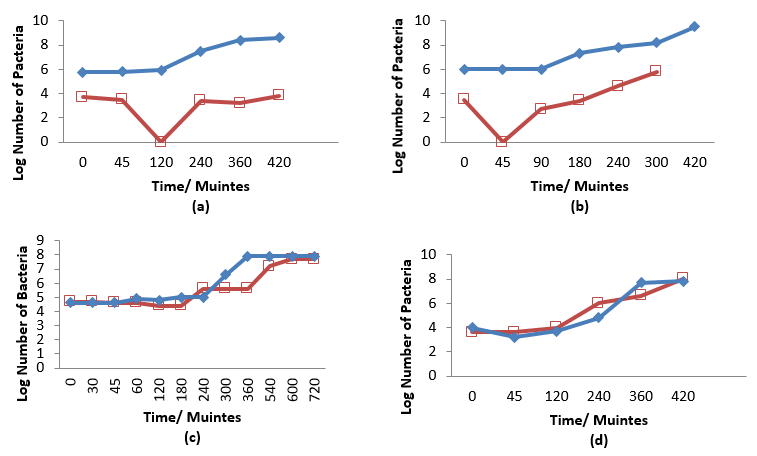
The PAE durations of the ciprofloxacin in [Figure 1]. The longest PAE in this group was observed when using ciprofloxacin against Staphylococcus aureus (6 hours) and the shortest was against Pasteurella multocida (1–2 hours), whereas the PAE of ciprofloxacin was found to be 4 hours for Salmonella dublin. E. coli was found to be resistant to ciprofloxacin in all phases.
Discussion
The study of the delayed regrowth of surviving bacteria following cessation of antibiotic administration, the post-antibiotic effect (PAE), and related phenomena such as the integration of the pharmacological and antimicrobial profiles of drugs became known as pharmacodynamics and is increasingly being applied to the design of dose regimens (MacKenzie and Gould 1993).[8]
The results of this study were asserted with Chin and Neu (1987)[9] who’s mentioned that the ciprofloxacin produced an excellent PAE for most gram-negative bacteria and for S. aureus. The longest PAE in this study was observed when using ciprofloxacin against Staphylococcus aureus (6 hours). Also Licata, et al., (1997)[10] found that a pronounced suppression of bacterial growth extending to 4.8 and 6.5 hours was seen with exposure to ciprofloxacin at one-eighth and one-fourth the MIC of ciprofloxacin for S.aureus.
Our results were confirmed by Schierholz et al. (1998)[11] as they reported that antimicrobial agents are generally tested against bacteria in the log phase of multiplication to produce the maximal bactericidal effect. From the above results, in the log phase the bacterial cells are more fragile since they are dividing in an accelerated rate and this makes the cells of the bacteria more susceptible to antibiotics and they will be more susceptible to external environment.
The PAE for Salmonella dublin when it was subjected to an antibiotic (1µg /ml ciprofloxacin) was “2 hours” which represents the beginning of the log-phase. It was observed that at time “2 hours” the number of bacteria decreased and reached zero. Majtán and Majtánová, (1997)[12] was observed the longest PAE result with Salmnella typhimurium after treatment with ciprofloxacin in compared with other antibiotic.
Over the past three decades, quinolone resistance in Enterobacteriaceae from human and veterinary isolates has increased (Rodríguez-Martínez et al., 2016b).[13] Therefore, this result supported our findings that the E. coli was found to be resistant to ciprofloxacin in all phases.
In the present study, the in-vitro PAEs of ciprofloxacin determination against different species of bacteria (Salmonella dublin, Pasteurella multusida and Staphylococcus aureus were found to be ranged between 1-6 hours for all species. The E.coli found to be resistant in all growth phases.
Source of Funding
None.
Conflict of Interest
The authors declare that there is no conflict of interest.
References
- Craig W, Gudmundsson S, VL. Postantibiotic effect. Antibiotics in laboratory medicine. 1996. [Google Scholar]
- Craig W. Post-antibiotic effects in experimental infection models: relationship to in-vitro phenomena and to treatment of infections in man. J Antimicrob Chemother. 1993;31(suppl D):149-58. [Google Scholar]
- Craig W, Gudmundsson S, Lorian V. The postantibiotic effect. Antibiotics in Laboratory Medicine. 1999. [Google Scholar]
- Beam T, Gilbert D, Kunin C. General Guidelines for the Clinical Evaluation of Anti-Infective Drug Products. Clin Infect Dis. 1992;15(Supplement_1):S5-S32. [Google Scholar]
- Bigger J. Treatment of staphylococcal infections with penicillin by intermittent sterilisation. Lancet. 1944;244(6320):497-500. [Google Scholar]
- Barrow G, Feltham R. . Cowan and Steel's manual for the identification of medical bacteria. 2003. [Google Scholar]
- Miles A, Misra S, Irwin J. The estimation of the bactericidal power of the blood. Epidemiol Infect. 1938;38(6):732-49. [Google Scholar]
- MacKenzie F, Gould I. The post-antibiotic effect. J Antimicrob Chemother. 1993;32(4):519-37. [Google Scholar]
- Chin N, Neu H. Post-antibiotic suppressive effect of ciprofloxacin against gram-positive and gram-negative bacteria. Am J Med. 1987;27(4A):58-62. [Google Scholar]
- Licata L, Smith C, Goldschmidt R, Barrett J, Frosco M. Comparison of the postantibiotic and postantibiotic sub-MIC effects of levofloxacin and ciprofloxacin on Staphylococcus aureus and Streptococcus pneumoniae.. Antimicrob Agents Chemother. 1997;41(5):950-5. [Google Scholar]
- Schierholz J, Beuth J, Pulverer G. Killing effects of antibiotics and two-fold antimicrobial combinations on proliferating and non growing staphylococci. Zentralblatt für Bakteriol. 1998;288(4):527-39. [Google Scholar]
- Majtán V, Majtánová L. Postantibiotic effects and postantibiotic sub-MIC effects of ciprofloxacin, pefloxacin and amikacin on the biological properties ofSalmonella strains. Folia Microbiol. 1997;42(4):327-32. [Google Scholar]
- Martínez J, Santiso R, Machuca J, Bou G, Pascual Ã, Fernández J. Assessment of Chromosomal DNA Fragmentation by Quinolones in an Isogenic Collection of Escherichia coli with Defined Resistance Mechanisms. Microbial Drug Resist. 2016;22(5):354-9. [Google Scholar]
Article Metrics
- Visibility 1k Views
- Downloads 233 Views
- DOI 10.18231/j.ijpp.2020.044
-
CrossMark

- Citation
- Received Date October 24, 2020
- Accepted Date November 06, 2020
- Publication Date January 25, 2021