Journal of International College of Dentists
Journal of International College of Dentists (JICD) is an open-access, peer-reviewed, Quarterly journal publishing under the auspices of the International College of Dentists. As soon as the Article is accepted for Publication, it will be placed in “Ahead of Print” on the journal page with the aim of rapid and better knowledge dissemination. In addition, the journal allows free access (Open Access) to its contents, which is likely to attract more readers and citations to articles published in journal. Manuscripts must be prepared under the “Uniform requirements” of the ...
Three paths to crossbite correction: A pediatric case series

Abstract
Introduction: Anterior crossbite is a common malocclusion in pediatric dentistry, characterized by one or more maxillary incisors occluding lingual to the mandibular incisors. If untreated, it may cause functional shifts, periodontal trauma, aesthetic concerns, and skeletal discrepancies. Early diagnosis and intervention during mixed dentition stage are crucial, as timely correction restores normal occlusion and prevents progression into complex orthodontic problems. Various interceptive approaches have been advocated, each with distinct advantages and limitations in terms of compliance, treatment duration, and stability. Case Series: Three pediatric patients between 8 and 11 years of age, all in the mixed dentition stage, presented with anterior crossbite. Each was managed using a distinct orthodontic approach tailored to clinical presentation and patient needs, with documentation of profile, diagnosis, treatment plan, duration, and outcome. The cases were compared for efficiency, compliance, and stability, offering insights into the relative effectiveness of different interceptive strategies.
Conclusion: This case series demonstrates that anterior crossbite management in the mixed dentition is effective in achieving functional and aesthetic correction while preventing progression to complex malocclusions. Treatment choice should be guided by patient age, severity, arch space, and compliance to ensure stable outcomes. These cases underscore the importance of individualized treatment planning—where clinical precision meets patient centered care—and remind us that the most effective orthodontic solutions are those tailored not just to teeth, but to the child behind the smile.
1. Introduction
In the delicate balance of a child’s developing occlusion, even a single tooth out of harmony can reshape function, aesthetics, and growth.
A single-tooth crossbite represents a distinct type of malocclusion, characterized by the abnormal positioning of an individual tooth such that it fails to achieve the optimal labiolingual relationship with its antagonistic counterpart. This results in the tooth being displaced palatally, lingually, or labially in relation to its opposing tooth.[1] Such crossbites may be dental in origin—arising from malposition of the tooth alone or may reflect skeletal or functional discrepancies, necessitating careful clinical differentiation.[2] Epidemiological studies report anterior crossbite prevalence in schoolchildren with mixed dentition range from 2.2–12.6% across population influenced by age, ethnicity, and whether primary, mixed, or permanent dentition is assessed.[3] Anterior crossbites are most frequently seen during mixed dentition phase, with single-tooth involvement being the commonest presentation. Their occurrence across both dentitions underscores clinical importance, guiding the timing and choice of intervention in pediatric patients.[4]
The aetiology of anterior crossbite is multifactorial, involving dental, skeletal, and functional influences during occlusal development.[4] Dental factors such as delayed exfoliation, supernumerary teeth, odontomas, crowding, or trauma to primary incisors can disrupt eruption paths, while skeletal influences like Class III growth patterns and genetic predisposition further contribute to anterior crossbite.[5] Functional factors including premature contacts, tongue thrust, mandibular posturing, and habits such as lip biting intensify the risk, particularly with the eruption of permanent teeth.[6]
Anterior crossbite, if left untreated, can compromise function, aesthetics, and periodontal health, while also predisposing to skeletal discrepancies. Early interceptive correction during the mixed dentition phase not only restores normal occlusion but also harnesses growth potential to achieve stable outcomes.[2] Timely management is therefore essential to prevent progression into complex malocclusions and to ensure optimal long-term dental health.
A range of interventions has been developed for its management, with the choice guided by patient age, aetiology, stage of dental development, and complicating factors.[6] Interceptive approaches in growing patients are emphasized, as early correction prevents long-term complications and utilizes active growth for stable outcomes.[2] Simple methods such as tongue blade therapy may be effective in mild cases with good compliance, while removable appliances like Hawley’s with Z-spring, expansion plates, or acrylic inclined planes are widely used in the mixed dentition phase.[2] For greater control and efficiency, fixed appliances such as the 2×4 appliance have gained prominence, particularly in complex cases.[7] Ultimately, treatment selection must be individualized, balancing severity, compliance, and long-term stability to ensure optimal functional and aesthetic results.[8] Therefore, the following case series illustrates the practical application of these modalities in three pediatric patients, highlighting individualized treatment planning and clinical outcomes
2. Case Series
2.1. Case 1
An 8-year-old female patient reported to the Department of Pediatric and Preventive Dentistry with the chief complaint of irregularly aligned anterior teeth. Her medical and family histories were non-contributory and no deleterious oral habits were observed. Intraoral examination revealed mixed dentition with maxillary right central incisor (tooth 11) positioned palatally while the maxillary left central incisor (tooth 21) displaced labially, contributing to anterior crossbite. Mild crowding was also noted in the mandibular anterior region. The molar relationship was Angle’s Class I, with no evidence of skeletal discrepancy. The gingival and periodontal status appeared healthy, and no traumatic occlusion was observed. It was first checked whether the mesiodistal distance to allow the labial movement of maxillary permanent anterior teeth was sufficient in children, and it was confirmed that there were no skeletal abnormalities. Cephalometric analysis revealed a normal facial-maxillo-mandibular relationship. Based on clinical and radiographic findings, a diagnosis of Angle’s Class I malocclusion with anterior crossbite involving teeth 11 and 21 was established. The case was considered suitable for interceptive orthodontic management, given the patient’s age, stage of dental development, and aesthetic concerns. Based on the clinical and radiographic findings, a comprehensive treatment plan was formulated. The patient was advised tongue blade therapy using an ice-cream stick, with instructions to apply gentle, repeated labial pressure on the palatally displaced maxillary right central incisor (11) by placing tongue depressor behind the tooth using the chin as a fulcrum. The exercise was prescribed for 5 minutes, four times a day, over a two-week period, ensuring consistent force application and effective correction under parental supervision.
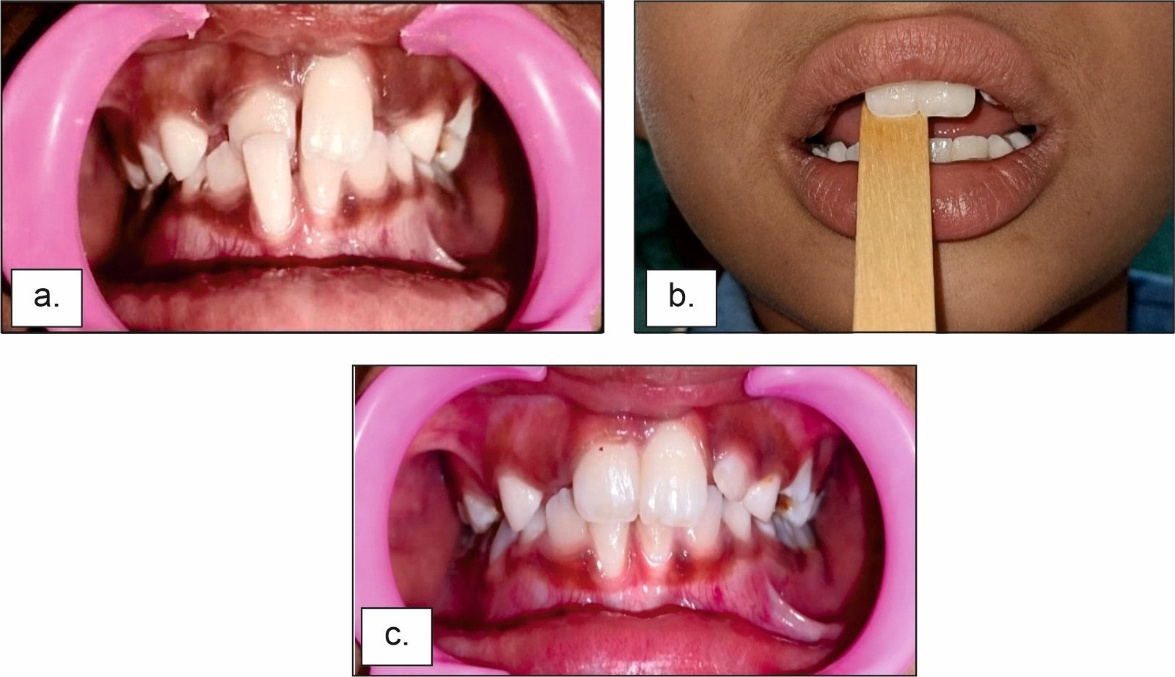
At the two-week follow-up, partial correction was observed, with the crossbite reduced to an edge-to-edge relationship with the opposing mandibular left central incisor. To reinforce motivation and compliance, patient was instructed to continue exercise for an additional two weeks, aided by a mirror for visual feedback and self-encouragement. After four weeks of therapy, complete correction was achieved. The child was placed on recall and instructed to continue routine oral care. At six-month follow-up, corrected tooth remained in proper position without any evidence of relapse. At one-year follow-up, stability was confirmed with the incisor maintaining its corrected alignment and functional occlusion preserved. The case pictures are illustrated in Figure 1.
2.2. Case 2
A 12-year-old female patient presented to the Department of Pediatric and Preventive Dentistry with the chief complaint of irregularly aligned upper anterior teeth and aesthetic concerns. Her medical and family histories were non-contributory, and no deleterious oral habits were reported. Intraoral examination revealed the patient to be in the late mixed dentition stage, with the maxillary left central incisor (tooth 21) positioned palatally, resulting in an anterior crossbite and contributing to anterior segment irregularity. The molar relationship was Angle’s Class I bilaterally, with healthy gingival and periodontal status and no signs of traumatic occlusion apart from anterior interference. Space analysis confirmed inadequate mesiodistal clearance for labial movement of the displaced incisor. Cephalometric evaluation revealed a harmonious maxillo-mandibular relationship without skeletal abnormalities. Based on clinical and radiographic findings, a diagnosis of Angle’s Class I malocclusion with anterior crossbite involving tooth 21 was established.
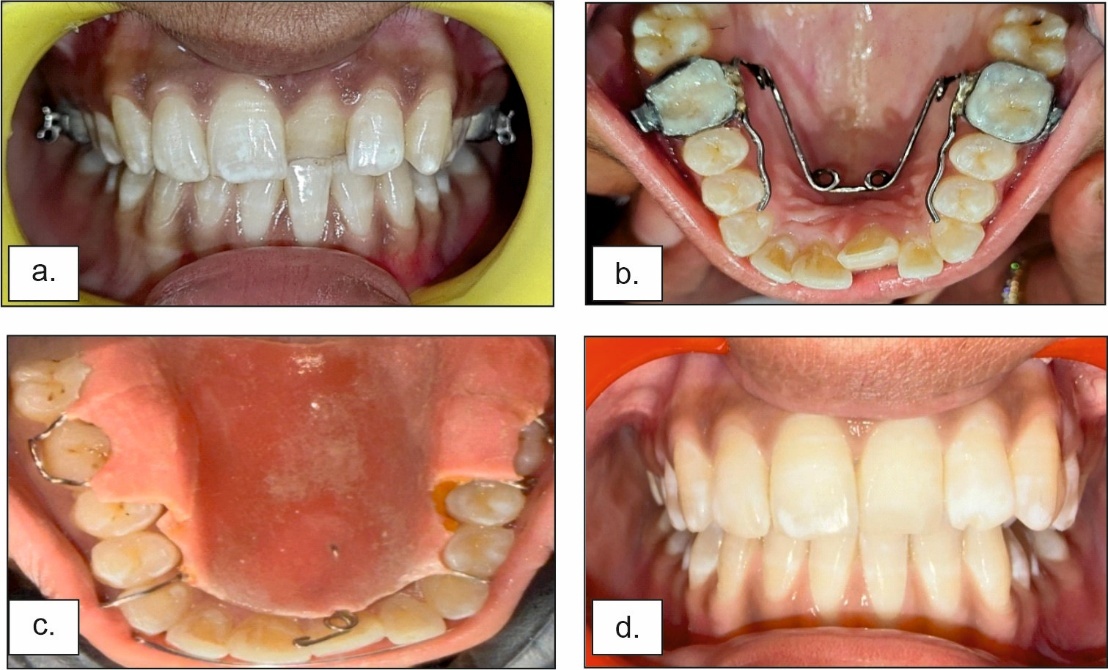
Considering the patient’s age, stage of dental development, and esthetic concerns, an interceptive orthodontic approach was selected. Management was initiated with maxillary arch expansion using a quad helix appliance cemented on the maxillary first permanent molars. To facilitate disocclusion of the anterior teeth and allow unhindered labial movement, the posterior bite was simultaneously raised using composite build-ups on the mandibular permanent molars. The appliance was activated approximately every four weeks, producing 1.5–2 mm of expansion per adjustment. Over five months, a total of 6–7 mm of maxillary arch expansion was achieved. This provided sufficient space for the labial movement of the palatally displaced tooth 21 and improved overall arch form. The expansion was stable, with no evidence of tipping or periodontal compromise.
Following successful expansion, a Hawley’s appliance with Z-spring was delivered to specifically address tooth 21. The Z-spring fabricated from 0.5 mm stainless steel wire and embedded in the acrylic plate, was activated at two-week intervals over a period of two months with adjustments of about 1 mm at each visit to maintain optimal force levels. Over the course of two months, progressive improvement was observed, with tooth 21 gradually moving into proper alignment. By the end of the activation period, the anterior crossbite was fully corrected, establishing normal overjet and overbite. The appliance was then maintained passively to consolidate the correction. The sequential use of quad helix expansion followed by Z-spring activation achieved complete correction of the anterior crossbite. Esthetics and functional occlusion were restored, and stability was confirmed at three-month and six-month follow-ups. At the one-year review, the corrected tooth remained in position without relapse, underscoring the effectiveness of combining arch expansion with targeted Z-spring activation in interceptive. The case pictures are illustrated in Figure 2.
2.3. Case 3
An 11-year-old male patient presented to the Department of Pediatric and Preventive Dentistry with the chief complaint of irregularly aligned upper anterior teeth and aesthetic concerns. His medical and family histories were non-contributory, and no deleterious oral habits were reported. Intraoral examination revealed the patient to be in the mixed dentition stage, with noticeable anterior crowding and pigmentation in the lower anterior gingiva. The maxillary left central incisor (tooth 21) was positioned palatally compounded by interference from the mandibular left central incisor (41) resulting in an anterior crossbite. The molar relationship was Angle’s Class I bilaterally, with healthy gingival and periodontal status and no signs of traumatic occlusion. Space analysis confirmed adequate mesiodistal clearance for labial movement of the displaced incisors. Cephalometric evaluation revealed a balanced facial profile and a harmonious maxilla-mandibular relationship, with no skeletal discrepancies. Based on clinical and radiographic findings, a diagnosis of Angle’s Class I malocclusion with anterior crossbite involving teeth 21 was established.
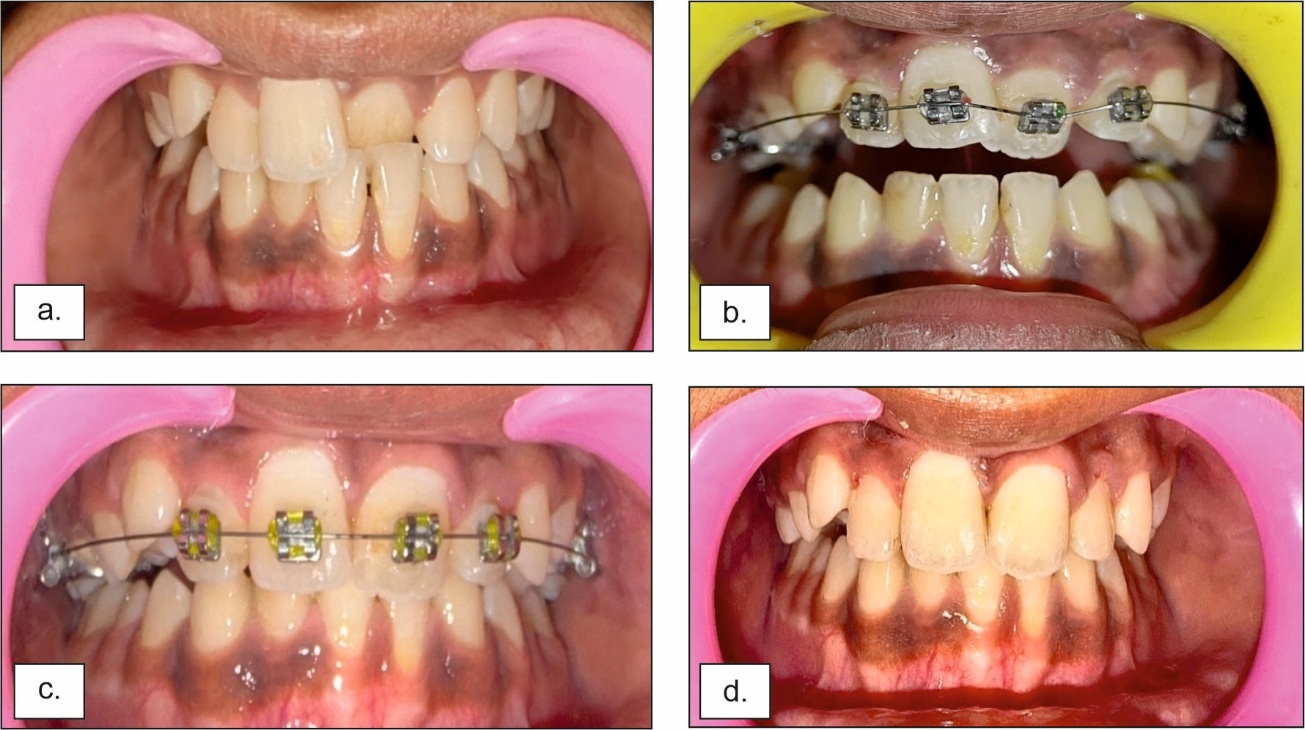
Given the patient’s age, dental development stage, and aesthetic concerns, treatment was initiated by fixed orthodontic management using a 2 × 4 appliance. This appliance consists of molar bands with buccal tubes cemented on teeth 16 and 26 and brackets with a 0.018″ slot bonded to the maxillary incisors (12, 11, 21, 22). To eliminate occlusal interference, posterior occlusal height was raised by 2 mm composite on the mandibular molars. A 0.012″ Ni-Ti round archwire was engaged into the bracket slots and molar tubes, then stabilized with orthodontic modules to deliver light, continuous forces. Within three weeks, positive overjet was achieved, and tooth 21 was corrected into proper alignment. Brackets and bite-raising were then removed, restoring normal occlusion.
The patient was placed on periodic recall. At three-month and six-month follow-ups, corrected tooth position remained stable, with no relapse. At one-year review, anterior segment was well aligned, confirming the long-term stability of the correction. This case demonstrated the efficiency of the 2×4 appliance combined with bite-raising in achieving rapid and stable correction of anterior crossbite in the mixed dentition stage. The case pictures are illustrated in Figure 3.
3. Discussion
Anterior crossbite is one of the most frequently encountered malocclusions in the mixed dentition stage. It is characterised by the lingual positioning of one or more maxillary anterior teeth relative to the mandibular incisors in centric occlusion. The prevalence varies between 4–5% in children with mixed dentition, with dental anterior crossbite being more common than skeletal forms.[9] The aetiology is multifactorial where dental causes include abnormal eruption paths, retained deciduous teeth, localized crowding, or trauma to primary incisors and skeletal causes involve maxillary deficiency or mandibular prognathism; and habitual factors such as tongue thrusting or lip habits may also contribute.[4][5][6] If left untreated, anterior crossbite can lead to a cascade of complications including traumatic occlusion, gingival recession, periodontal compromise, and functional shifts that predispose to asymmetric mandibular growth. With time, these changes may progress to a skeletal Class III malocclusion, often necessitating complex orthodontic or even surgical intervention. Early interceptive management is therefore essential, not only to prevent long-term complications but also to restore aesthetics and function during a child’s formative years.
A wide range of treatment modalities have been described for interceptive correction of anterior crossbite. In this case series, three different interceptive orthodontic modalities were employed for the correction of anterior crossbite in the mixed dentition stage: tongue blade therapy, removable appliance therapy (quad helix expansion followed by Z-spring activation), and fixed orthodontic management using the 2 × 4.
Tongue blade therapy has long been recognized as a simple, non-invasive interceptive technique for correcting mild anterior crossbite in children. The method involves applying gentle, repeated labial pressure with a tongue depressor to reposition the displaced tooth, under parental supervision. The anterior crossbite correction with tongue blade therapy can be achieved within 3–4 weeks when patient compliance is high. Herawati et al., further demonstrated its effectiveness as a cost-efficient, well-accepted technique that avoids the bulk and expense of orthodontic appliances.[10] Similarly, Amudala et al., documented successful outcomes in younger children with mild dental anterior crossbite, with correction typically achieved within 2–4 weeks.[11] In the present case series, Case 1 supported these findings as tongue blade therapy successfully corrected the anterior crossbite within four weeks. The child’s compliance and parental supervision were crucial to the outcome, and stability was maintained at six-month and one-year follow-ups, underscoring the long-term effectiveness of this simple interceptive approach.
Expansion appliances such as the quad helix are particularly effective in cases with transverse arch constriction, as they relieve crowding and create space for proper alignment. In clinical practice, the quad helix is typically activated by expanding the helices 2–3 mm prior to insertion, with adjustments made every 4–6 weeks depending on arch development. Removable appliances like Hawley’s with Z-spring further deliver controlled labial forces, particularly useful when clearance is limited. Batra et al., reported successful correction of a single anterior tooth crossbite using an expansion appliance with Z-spring and posterior bite plane, achieving stable results in mixed dentition.[5] Similarly, asymmetric maxillary expansion with a quad helix for unilateral crossbite, which also created space for anterior alignment, later refined with Z-spring activation for incisor repositing. Case 2 illustrated the sequential use of quad helix expansion followed by Z-spring activation, achieving gradual arch development and controlled tooth movement over seven months. The correction remained stable at one-year follow-up, reinforcing the effectiveness of combining expansion with removable mechanics in moderate cases.
Fixed appliances such as 2 × 4 appliance, involving molar bands and brackets on four incisors, are highly efficient and predictable for moderate to severe displacement. Proffit emphasized their rapid correction capability, often achieving positive overjet within weeks, with minimal reliance on patient compliance.[9] This allows precise control of tooth movement and is particularly suited for children where compliance with removable appliances is limited. Clinically, activation begins with placement of a Ni-Ti archwire (0.012″), which provides continuous low-force alignment. Subsequent activations involve progressive archwire changes or elastic auxiliaries to refine overjet and incisor positioning, while posterior bite-raising is maintained until positive overjet is achieved. In the present case series, Case 3 demonstrated efficiency of the 2 × 4 appliance, achieving positive overjet within two weeks and maintaining stability till one year. This outcome underscores the value of fixed mechanics in delivering rapid, reliable correction in complex presentations, provided oral hygiene is carefully monitored.
The selection of an appropriate interceptive modality for anterior crossbite correction depends on multiple factors, including the patient’s age, severity of displacement, arch space availability, and anticipated compliance. Tongue blade therapy is best suited for younger children (6–9 years) presenting with mild dental crossbite. It is non-invasive, highly cost-effective, and well accepted by patients, though its success is heavily dependent on daily compliance and parental supervision. In cases involving arch constriction or limited clearance, particularly in children aged 8–12 years, a staged approach using quad helix expansion followed by Hawley’s appliance with Z-spring activation offers gradual space creation and controlled labial movement of incisors. But this method requires moderate compliance, longer treatment duration (6–8 months), and may cause soft tissue irritation or speech interference due to appliance bulk. For older children (10–13 years) with moderate to severe displacement, fixed orthodontic therapy using the 2×4 appliance provides rapid and precise correction, typically within 2-4 weeks. This modality demands minimal patient compliance and yields high success rates; however, it is relatively more costly and necessitates vigilant oral hygiene to prevent risks such as decalcification. Post-treatment follow-up remains essential across all modalities to ensure long-term stability, with multiple studies confirming sustained results at one-year follow-up. [Table 1] demonstrate the differences between three treatment modalities. Together, these cases underscore the importance of individualized treatment planning—where clinical precision meets patient centered care—and remind us that the most effective orthodontic solutions are those tailored not just to teeth, but to the child behind the smile.
|
Criteria |
Tongue blade therapy |
Quad helix + Hawley’s with Zspring |
2 × 4 Fixed appliance |
|---|---|---|---|
|
Age Suitability |
6–9 years Mild dental crossbite |
8–12 years Arch constriction + dental displacement |
10–13 years Moderate/severe displacement |
|
Duration |
4 weeks |
6–8 months |
3–4 weeks |
|
Success Rate |
High |
High |
Very high |
|
Patient Acceptance |
Good (non-invasive) |
Moderate (bulkier appliance) |
High (rapid results) |
|
Compliance |
Requires daily effort |
Moderate; parental supervision needed |
Minimal compliance needed |
|
Retention |
Stable if corrected early |
Stable with passive retention |
Stable with short passive retention |
|
Cost Effectiveness |
Cost effective |
Moderate cost |
Higher cost |
|
Adverse Effect |
Limited to mild cases; relapse if poor compliance |
Soft tissue irritation; speech interference |
Risk of gingivitis and decalcification if hygiene is poor |
4. Conclusion
Anterior crossbite in mixed dentition can be effectively managed with timely interceptive orthodontics. The three cases presented illustrate how treatment choice must be guided by age, severity of displacement, arch space availability, and expected compliance. Tongue blade therapy is economical and patient-friendly for mild cases, quad helix with Z-spring provides stable correction in moderate cases with space loss, and the 2 × 4 appliance ensures the fastest and most predictable results for complex cases. Ultimately, these cases affirm that when interceptive strategies are chosen with precision, a small correction today evolves into a lifetime of confident smiles tomorrow.
5. Authors Contributions
Charu Aggarwal: Data curation, funding acquisition, investigation, validation, writing – original draft. Sonal Gupta: Scientific advisor, writing – review editing. Rohan Shrivastava: Formal analysis, methodology, resources. Nayana Abraham: Formal analysis, software. Akil Prawin S S: Formal analysis, scientific advisor, writing – review editing. Muskan Mishra: Investigation, resources, writing – original draft.
6. Source of Funding
None.
7. Conflict of Interest
None.
8. Patient Consent
Written informed consent was obtained from all three patients before inclusion their data in this study for publication.
References
- Al-Qallaf RM. Treatment of anterior cross bite: a review of literature and case report. Int J Appl Dent Sci. 2023;9(3):111-114. [Google Scholar] [Crossref]
- Alaoui ML, Chhoul H. Management of anterior single tooth crossbite in mixed dentition: a case report. IOSR J Dent Med Sci. 2019;18(8):11-14. [Google Scholar] https://www.iosrjournals.org/iosr-jdms/papers/Vol18-issue8/Series-11/C1808111114.pdf
- Khalaf K, Mando M. Removable appliances to correct anterior crossbites in the mixed dentition: a systematic review. Acta Odontol Scand. 2020;78(2):118-125. [Google Scholar] [Crossref]
- Sharma MN, Jain RK. Prevalence and associated factors in subjects with crossbite malocclusion reporting to a private dental hospital. Int J Early Child Spec Educ. 2022;14(5):4175-4185. [Google Scholar] [Crossref]
- Batra P, Agarwal I, Katyal S. Anterior crossbite correction using a removable orthodontic appliance: a case report. MOJ Clin Med Case Rep. 2022;12(1):1-3. [Google Scholar] [Crossref]
- Alami S, Aghoutan H, El Quars F, Diouny S, Bourzgui F. Early treatment of anterior crossbite Relating to Functional Class III. Virdi MS (editor). Emerging Trends in Oral Health Sciences and Dentistry. London: Infotech Open; 2015. [Google Scholar] [Crossref]
- Gawali P, Jadhav G, Shigli A, Vaidya P. 2×4 appliance: effective treatment modality for anterior crossbite. Ann Int Med Dent Res. 2019;5(5):1-2. [Google Scholar] https://www.aimdrjournal.com/wp-content/uploads/2021/07/DE1_CR_Pritesh-edit1.pdf
- Wiedel AP, Bondemark L. Fixed versus removable orthodontic appliances to correct anterior crossbite in the mixed dentition--a randomized controlled trial. Eur J Orthod. 2015;37(2):123-127. [Google Scholar] [Crossref]
- Proffit WR, Fields HW, Sarver DM. Contemporary Orthodontics. 5th ed. St. Louis: Mosby; 2018. [Google Scholar] https://shop.elsevier.com/books/contemporary-orthodontics/proffit/978-0-323-08317-1
- Herawati H, Solihat LW. Anterior crossbite treatment using tongue blade in eight-year-old children via teledentistry during pandemic. J Health Dent Sci. 2022;1(3):267-274. [Google Scholar] [Crossref]
- Amudala N, Sandeep K, Martha S, Athyala A, Sadik MA, Anudeep M, et al. Management of anterior crossbite in mixed dentition: a case series demonstrating successful treatment strategies. J Res Med Dent Sci. 2023;10(4):68-74. [Google Scholar] https://www.researchgate.net/publication/370230241_Exploring_Management_Techniques_for_Crossbite_Correction_A_Case_Series_Demonstrating_Successful_Treatment_Strategies
Article Metrics
- Visibility 141 Views
- Downloads 147 Views
- DOI 10.18231/j.jicd.26725.1792218430
-
CrossMark

- Citation
- Received Date May 04, 2026
- Accepted Date October 12, 2026
- Publication Date October 17, 2026