Indian Journal of Clinical Anatomy and Physiology
Indian Journal of Clinical Anatomy and Physiology (IJCAP) is an open access, peer-reviewed medical quarterly journal, published since 2014 under the auspices of the Innovative Education and Scientific Research Foundation (IESRF), which aims to uplift researchers, scholars, academicians, and professionals in all academic and scientific disciplines. IESRF is dedicated to the transfer of technology and research by publishing scientific journals, research content, providing professional memberships, and conducting conferences, seminars, and award programs....
Comparison of mind mapping and didactic instructional method in learning neuroanatomy for first MBBS students
Abstract
Background: A self-explanatory, multidimensional yet tailor made method is needed to teach complex and intricate networks in Neuroanatomy. Mind maps use a 360 approach-a central theme, radially expanding concepts explained using colours, pictures, interrelated & strategic arrangement. Mind maps are tools of active learning using constructivist theory.
Objective: To compare mind mapping and didactic instructional method in learning neuroanatomy for first MBBS students. To assess students’ perception about mind mapping.
Methodology: Random controlled cross over study design was used. Pre-validated multiple-choice questions were used to assess the knowledge scores. Knowledge scores were compared by unpaired t and Mann-Whitney u test.
Results: Mean Knowledge scores of students in mind mapping group were better than students in didactic lecture group. The difference was statistically significant by applying quantitative [p value < 0.0001, at 95% confidence interval] and qualitative [p value < 0.05]test.
Conclusion: Mind mapping helps in better recall and is effective in teaching complex conceptual subjects.
Introduction
Complex and intricate network of connections makes Neuroanatomy a difficult subject. Students are expected to know topography, functional connections and clinical significance of these connections. Teaching hours dedicated to Neuroanatomy are less due to overall reduction of time for I medical professional year. Complexity of subject and shortage of time leads to “neurophobia” in students.[1] Challenge of Teaching neuroanatomy needs self-explanatory, multidimensional yet tailor made method. Digital tools and 3D physical models are commonly used.[2] But learner involvement is minimal in these methods. Mind maps use a 360 approach-a central theme, radially expanding concepts explained using colours, pictures, interrelated & strategic arrangement. Mind maps are interesting, self-explanatory, innovative and can be prepared by students. Mind maps are tools of active learning technics using constructivist theory.[3] We conducted this study to compare mind mapping and didactic instructional method in learning neuroanatomy for first MBBS students.
Objectives
To assess perceptions of students regarding Mind Mapping in teaching neuroanatomy.
To compare knowledge scores students by Mind Mapping and lecture methods in neuroanatomy using multiple choice questions.
Materials and Methods
Institutional ethical committee clearance was obtained.
Inclusion criteria
Students willing to participate in study.
Exclusion criteria
Absentee / students not willing to participate in study.
Sampling technique
St year medical professional students [80] were devided into two groups by random sampling.
Group I –Mind mapping.
Group II – Didactic lecture.
Data collection Group ILesson plan was followed and explained by using Mind map for 45 minutes followed by clarification of any doubts.
Group IILesson plan prepared and explained topic using black board for 45 minutes followed by clarification of any doubts.
Post test
After the session on spinal cord, Knowledge scores were assessed using pre-validated multiple-choice questionnaire for both the groups immediately by 2 different faculties for 10 minutes.
Same method used for session II on thalamus after crossing the groups.
After mind mapping session, a feedback was obtained from the students regarding perceptions of mind mapping as teaching method using questionnaire on Likert scale from strongly disagree to strongly agree.
Statistical methods
Perceptions of students on mind mapping as teaching method using questionnaire is expressed as percentage of response favouring this method.
Descriptive statistics
Parametric test -two tailed unpaired ‘t’ test was applied to compare the knowledge scores of students. Non parametric test- rank based, Mann – Whitney u test was applied
Results
Perceptions of students on mind mapping as teaching method
50 to 60% students strongly agreed mind mapping is interesting, innovative and increased attention. 45% strongly agreed the mind mapping made subject easier [[Figure 1] about perception of students here].
Knowledge scores
Students of mind mapping groups scored higher than didactic lecture group. In Students of mind mapping groups % age of students scoring higher marks was more than didactic lecture group [[Figure 2], [Figure 3] about students’ scores here.]
Parametric unpaired t test showed higher mean scores and Non-parametric Mann Whitney u test based on sum of ranks showed higher values in mind mapping group as compared to didactic lecture group. These differences were statistically significant [unpaired t test - p <0.0001, highly significant] [Mann- Whitney u test - p<0.05 significant] [[Table 1] about unpaired t test results & [Table 2] about Mann -Whitney u test results here.]
![Perceptions of students [in %] about mind mapping as teaching method](https://s3-us-west-2.amazonaws.com/typeset-media-server/b31542a5-1a35-4e8b-ab39-cd2c1653c6ceimage1.png)
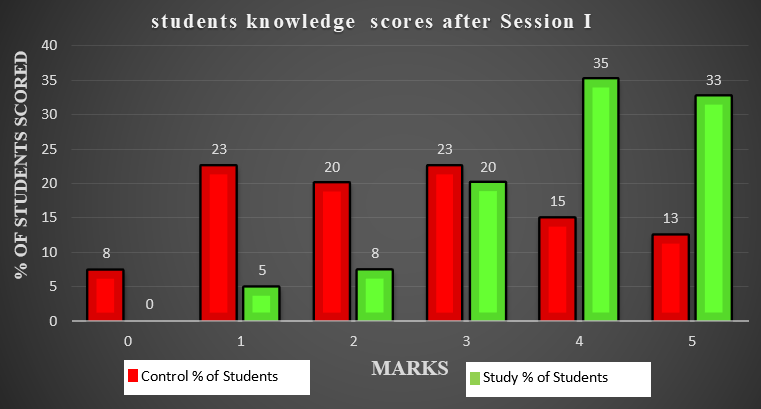
![Shows marks scored & % of students in study and control groups of second mind mapping session [after cross over]](https://s3-us-west-2.amazonaws.com/typeset-media-server/b31542a5-1a35-4e8b-ab39-cd2c1653c6ceimage3.png)
| Table Analyzed | Session I -Spinal Cord | Session II -Thalamus | ||
| Study | Control | Study | Control | |
| Mean | 2.53 | 3.83 | 2.10 | 4.18 |
| SD | 1.48 | 1.12 | 1.16 | 1.13 |
| Standard Error Mean | 0.18 | 0.24 | 0.17 | 0.16 |
| Difference between means | -1.30 ± 0.29 | -1.87 ± 0.23 | ||
| Independent t test (2- tailed) | 0.0792 (P < 0.0001) HS | 0.6264 (P < 0.0001) HS |
| Table Analyzed | Session I -Spinal Cord | Session II -Thalamus | ||
| n=40 | Study | Control | Study | Control |
| Sum of ranks | 2015 | 1226 | 2239 | 1002 |
| U | 405.5 | 181.5 | ||
| P | P < 0.05 | P < 0.05 |
Discussion
Perceptions of students on mind mapping as teaching method
90% students perceived mind mapping interesting, 82.5% said it increased attention and understood content better. 72% students agreed mind mapping is a creative method. 65% students recommended mind maps over traditional method. Students opinion about process included – “loved it”, “enjoyed it”, “very interesting and innovative”. Students suggestions included “should implement throughout academic year”, “I will use it for other subjects”. Results of a Semi structured interview-based study on social science showed that students enjoy creating and learning with mind maps.[4] Creating mind maps is difficult as it needs understanding information, conveying it in picture form and thinking strategically. This active thinking and learning help to assimilate the complex information as neuroanatomy. Making students familiar with technique and motivating them is required to achieve good results.[5]
Knowledge scores of students
Students of study group scored better than control group in both sessions of mind map. Mean score of study group for session I and II were 85% &73% and mean score of control group for session I and II were 50% & 38%. These findings were similar to those West et al. (2000), Hsu (2004), Laight (2004) of Abdolahi et al. (2011), Deshatty & Mokashi [2013] showed the improvement of learning by applying mind mapping.[6], [7], [8], [9], [10]
Abdolahi reported gross anatomy learning using mind maps is sex dependent. Bilateral use of neuronal networks in female students in studying mind maps helped them score better. [9] active learning, Organising, associating interdependent and non -linear concepts leads to better recall[11], [12] Ferrand et al reported mere 10% better recall of facts in mind map using group as compared to self-selected study group.[5] Our study showed 35-45% better mean scores in study group. We suggest more complex the topic, more useful can be the mind maps.
Students using mind map for note taking in science showed better learning of concept, academic achievement and attitudes towards science courses.[13] Scores are better with Student centred mind maps than teacher centred mind maps. Knowledge, Inductive reasoning, analysis, and approach to solve the problem in different context are integral to critical thinking.[14]
Limitations
We could not assess effect of mind maps on long term recall, critical thinking and student centre versus teacher centred. These aspects require longitudinal studies. we are planning towards conducting studies.
Conclusions
Students perceived Mind mapping as interesting, innovative and enjoyable method of learning. Mean Knowledge scores of students in mind mapping group were better than students in didactic lecture group. The difference is proved statistically significant by quantitative and qualitative test. We conclude Mind mapping is effective in teaching complex conceptual subjects. Mind mapping, a student-centered teaching learning method because of active participation, analytic thinking and visual presentation helps in better recall.
Source of Funding
None
Conflict of Interest
None.
References
- Jozefowicz RF. Neurophobia: The Fear of Neurology Among Medical Students. Arch Neurol. 1994;51(4):328-9. [Google Scholar]
- Arantes M, Arantes J, Ferreira MA. Tools and resources for neuroanatomy education: A systematic review. BMC Med Educ. 2018;18(1). [Google Scholar]
- Bodner GM. Constructivism: A theory of knowledge. J Chem Educ. 1986;63(10):873-8. [Google Scholar]
- Ayşegül Å, Ayça K. Views of the students on mind mapping technique in social studies course ankara university. J Fac Educ Sci. 2013;46(2):111-31. [Google Scholar]
- Farrand P, Hussain F, Hennessy E. The efficacy of the `mind map' study technique. Med Educ. 2002;36(5):426-31. [Google Scholar]
- West DC, Pomeroy JR, Park JK, Gerstenberger EA, Sandoval J. Critical thinking in graduate medical education: A role for concept mapping assessment? . JAMA. 2000;284(9):1105-10. [Google Scholar]
- Hsu LL. Developing concept maps from problem-based learning scenario discussions. J Adv Nurs. 2004;48:510-8. [Google Scholar]
- Laight DW. Attitudes to concept maps as a teaching/learning activity in undergraduate health professional education: influence of preferred approach to learning. Med Teach. 2006;28(2):e64-e7. [Google Scholar]
- Abdolahi M, Javadnia F, Bayat P, Ghorbani R, Ghanbari A, Ghodoosi B. Mind map teaching of gross anatomy is sex dependent. Int J Morphol. 2011;29(1):41-4. [Google Scholar]
- Deshatty DD, Mokashi V. Mind maps as a learning tool in anatomy. Int J Anat Res. 2013;1(2):100-3. [Google Scholar]
- Mento AJ, Martinelli P, Jones RM. Mind mapping in executive education: applications and outcomes. J Manag Dev. 1999;18(4):390-416. [Google Scholar]
- Vilela VV, Barbosa LCP, Vilela ALM, Neto LLS. The use of mind maps as support in medical education. J Contemp Med Edu. 2013;1(4):199-206. [Google Scholar]
- Akinoglu O, Yasar Z. The effects of note taking in science education through the mind mapping technique on students’ attitudes, academic achievement and concept learning. J Baltic Sci Educ. 2007;6(3):34-42. [Google Scholar]
- . Teacher-Centered Mind Mapping vs Student-Centered Mind Mapping in the Teaching of Accounting at Pre-U Level – An Action Researc. Procedia Soc Behav Sci. 2010. [Google Scholar]
- Abstract
- Introduction
- Objectives
- Materials and Methods
- Inclusion criteria
- Exclusion criteria
- Sampling technique
- Post test
- Statistical methods
- Descriptive statistics
- Results
- Perceptions of students on mind mapping as teaching method
- Knowledge scores
- Discussion
- Perceptions of students on mind mapping as teaching method
- Knowledge scores of students
- Limitations
- Conclusions
- Source of Funding
- Conflict of Interest
- References
Article Metrics
- Visibility 787 Views
- Downloads 148 Views
- DOI 10.18231/j.ijcap.2020.047
-
CrossMark

- Citation
- Received Date November 30, -0001
- Accepted Date November 30, -0001
- Publication Date June 27, 2020